NTRIP Correction Age and Network Interruptions in Drone Surveys
Trace correction availability through source identity, stream content, timestamps, network stages, receiver behavior, and the evidence needed for later processing.
Separate transport from positioning quality
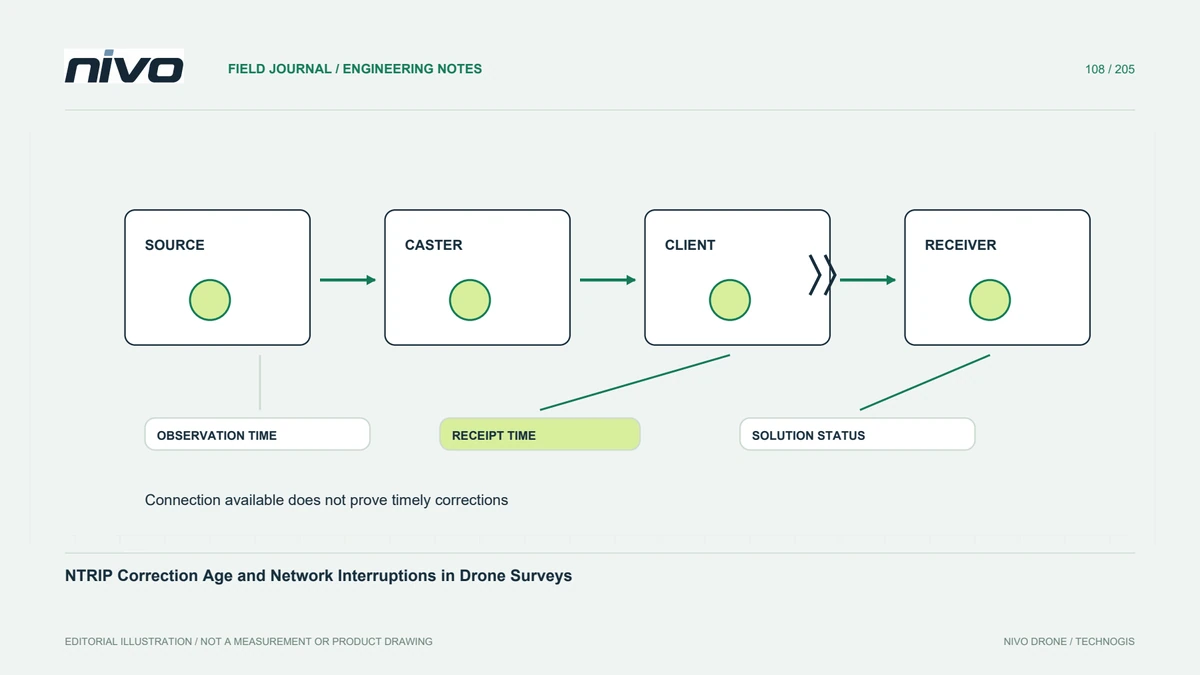
NTRIP transports GNSS-related data over an internet connection; a connected client does not by itself prove every required correction is current and usable. Identify the provider, selected stream, receiver configuration, and intended positioning workflow. Distinguish network connection status from receiver solution state. This keeps a green connection indicator from becoming a substitute for checking whether the actual observations support the task the survey team needs to perform.
Identify the data source and its meaning
Record stream identity, relevant reference information, content requirements, and the device receiving the data. A similarly named stream may not have the same characteristics. Changes in source or reference need review before results are combined. Keep private account details out of shared troubleshooting records. The useful technical information is the evaluated stream and configuration, not credentials copied into a report or a screenshot of a successful login.
Read correction age with the receiver documentation
A reported age or latency field has a definition within its implementation. Establish which timestamp and data it refers to before choosing an acceptance interpretation. There is no universal age threshold suitable for every receiver, correction type, and project requirement. Review actual behavior during interruptions and recovery through approved checks. Preserve the original records so a later analyst can determine which periods had the information required by the intended workflow.
Map the network stages
The path can include a correction source, caster, mobile network, client application, serial or radio interface, and receiver. Record where status and logs originate. A mobile signal icon cannot establish delivery at the final device. Compare relevant timestamps and known connection changes. This helps separate a provider interruption from local connectivity, interface congestion, or application behavior, avoiding repeated receiver reconfiguration when the evidence points to another stage.
Preserve options for data assessment
Where the confirmed system supports raw recording and later processing, identify the files needed before leaving the site. Post-processing is not an automatic remedy for every missing observation or reference problem. Review completeness, timing, source coordinates, and compatibility with the intended software. The operator's contingency plan remains separate from the data analyst's later options. Do not continue an unsupported workflow simply because somebody expects to repair it afterward.
Report interrupted periods transparently
Link connection events, receiver states, correction evidence, and affected mission segments. Explain the method used to assess outputs and any remaining limitation. A restored connection does not erase the history of the preceding interval. This record supports NiVO GNSS discussions with a bounded technical question and helps recipients distinguish confirmed usable results from periods needing additional checks, rather than assuming that one final successful status validates the entire survey.