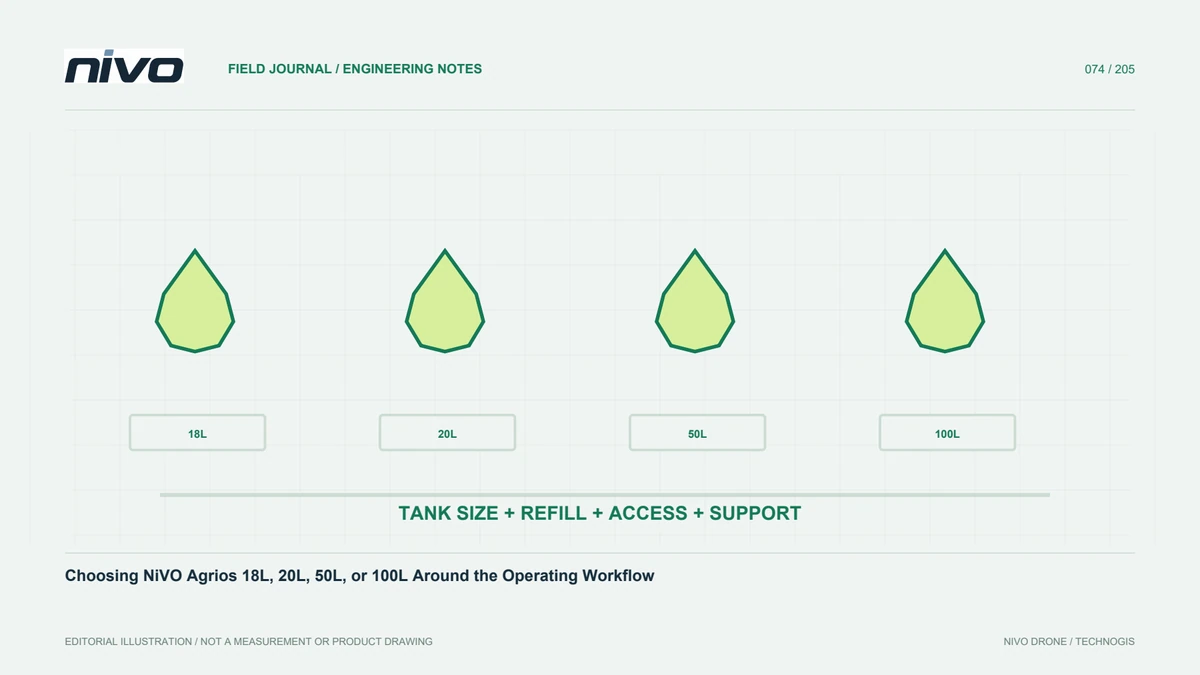
Choosing NiVO Agrios 18L, 20L, 50L, or 100L Around the Operating Workflow
Compare NiVO Agrios capacities through parcel geometry, access, refill logistics, energy, transport, team readiness, maintenance, and evidence from representative operations.
Use capacity as the start of evaluation
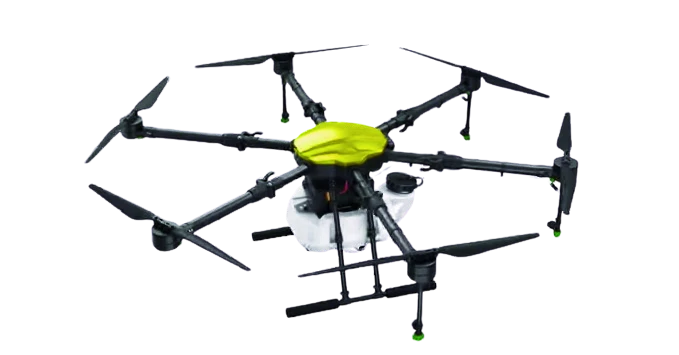
The NiVO Agrios family in this catalog includes 18L, 20L, 50L, and 100L options. Capacity helps establish initial choices but does not independently state productivity, endurance, or suitability for every field. Confirm operating parameters for the actual configuration through specifications and appropriate trials. Understand tasks, parcel shapes, access, and support before selecting a size. The largest tank is not automatically fastest overall. Capacity creates value when refill, energy, transport, and operating arrangements can support it in the circumstances where the system will actually work.
Map parcel geometry and travel between areas
Total area does not describe operational complexity. Separate small parcels can require frequent moves and setup compared with continuous land. Record access, obstructions, relief, boundaries, and operating locations under the responsible assessment. Check whether support vehicles can reach planned refill points. Small-field efficiency may depend more on organization than tank volume; large fields still suffer when logistics create waiting time. A detailed operations map allows comparisons using real work cycles and identifies likely bottlenecks before the team commits to one equipment capacity.
Confirm application requirements through technical assessment
Payload demand must follow the task, product, and application method approved by people who understand crop management and the equipment. Do not derive dosage or mixtures from tank volume. Confirm required volume, work pattern, and equipment needs through appropriate guidance. If information is missing, resolve it before estimating coverage. The same tank can require different cycle counts under different application needs. State assumptions openly. Separating agronomic requirements from vehicle capability prevents marketing figures from replacing a locally relevant operating design.
Treat refill support as part of the system
The cycle includes preparation, refilling, checks, operation, and subsequent handling. More capacity can change supply, transfer, and staffing requirements. Define how required materials and water are provided, who handles the process, and how records are kept according to relevant procedures. Do not ignore time outside flight. One support bottleneck can leave several devices waiting. Preserve task identity and avoid confusion between parcels or products. Capacity comparisons should include actual support work rather than only minutes spent airborne performing the planned application.
Assess energy, transport, and site readiness
Review capacity together with energy support, transport, workspace, and team readiness. Confirm model-specific batteries, charging, dimensions, mass, and handling. Do not assume variants differ only in tank size or transfer figures from another model. Plan movement and checks between areas. Remote sites may make logistics the decisive factor. Put these assumptions in the comparison matrix so purchasing staff understand why one size suits a particular operation but becomes less practical where access, transport, or support conditions are different.
Match roles and training to the operation
Operator and ground-team readiness influence repeatability. Assign aircraft operation, support preparation, parcel recording, equipment checks, and communication with the farm manager. Assess whether the team can carry out those roles using the relevant guidance. Do not expect one person to perform every task if the actual plan needs coordinated support. Brief parcel identities, objectives, boundaries, and review or stop conditions. Training should assess the complete work cycle, not flight alone. An informed team can maintain quality and explain productivity differences between days or sites.
Demonstrate productivity in a representative trial
Test land and work resembling the intended operation. Record preparation, refill, operation, travel, inspection, and end-of-task handling separately. Assess whether work quality meets agreed technical criteria, not simply area traversed or liquid used. When comparing capacities, make assumptions and conditions understandable and distinguish equipment effects from logistics. Report the tested circumstances rather than promising equal performance everywhere. Such evidence turns capacity selection into a traceable decision grounded in local operating needs instead of a comparison of tank labels or unsupported coverage claims.
Include maintenance and job changes
The program continues after the last application. Cleaning, checks, storage, and preparation for the next task need suitable time and facilities. Review access and handling for the specific configuration rather than assuming one model's procedure applies to another. Plan product or parcel changes through appropriate guidance and retain records. Include this time in fleet estimates. Documented maintenance supports readiness and investigation when equipment condition changes. Full-cycle cost and practicality belong in the evaluation alongside purchase price and nominal volume.
Bring clear field information to consultation
Provide parcel maps, area, access, obstacles, task type, confirmed application needs, schedule, and support-team arrangements. Request configuration details and a trial plan addressing those circumstances. Record why 18L, 20L, 50L, or 100L is selected and which assumptions remain. Resolve important unknowns before promising productivity. The right capacity fits the operating system and can be demonstrated through planned work. A NiVO discussion then focuses on delivery and field readiness rather than the unsupported belief that a single size must be best for every user and location.
Illustrative case: comparing Agrios capacity through complete work cycles
Imagine a hypothetical buyer comparing NiVO Agrios capacities for a property containing both connected fields and several small, separated parcels. The initial request selects the largest listed tank because total hectares appear substantial. The technical discussion instead separates field geometry, access, refill support, energy arrangements, transport, staffing, and the confirmed requirements of the intended application. The available 18L, 20L, 50L, and 100L choices remain options to evaluate, not evidence that any variant has a particular endurance or coverage rate. Missing configuration specifications are marked for confirmation before the team builds a productivity promise.
The proposed trial records a complete cycle rather than airborne time alone: preparation, appropriate loading support, operation, movement between parcels, checks, and post-task handling. Product-specific application decisions remain with qualified personnel and relevant guidance; the scenario does not derive dosage from tank size. The team compares a package suited to frequent moves with a package intended for a different support arrangement, documenting which constraints each must meet. If a support bottleneck dominates the timetable, changing capacity alone may not remove it. Any observed trial result is reported with its actual conditions rather than transferred automatically to every field or season.
Handover requires a configuration sheet, explicit operating assumptions, a responsibility plan, and evidence that the proposed logistics can be repeated by the intended team. The buyer should understand why one capacity is recommended for the defined workflow and which unanswered question could change that recommendation. A comparison table distinguishes confirmed product information from local trial observations and planning estimates. This hypothetical example shows that a defensible capacity choice fits a functioning operating system, rather than treating the largest volume as a universal answer or presenting an untested calculation as measured performance.