Scoping a Drone Project Before Aircraft and Payload Consultation
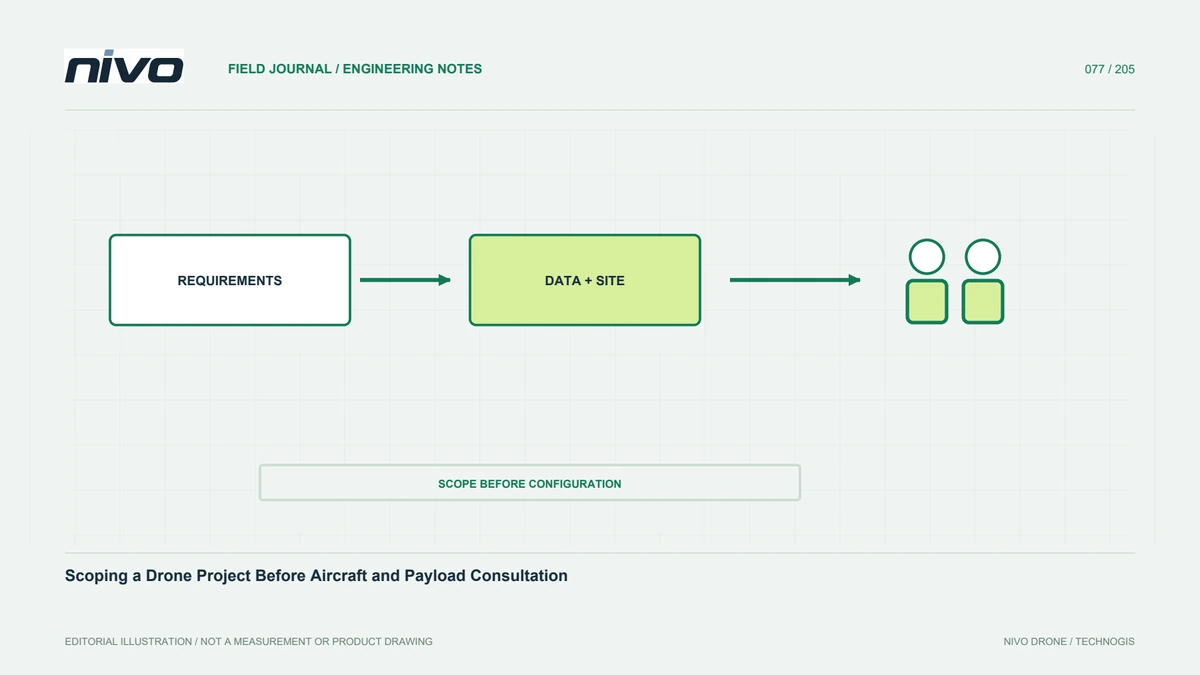
Prepare a clear drone-project brief covering outputs, targets, area, detail, accuracy, site conditions, timing, complete-system needs, data roles, and acceptance tests.
Turn a general request into a concrete output
Needing a mapping or inspection drone is too broad to determine a configuration. Start with the deliverable: orthomosaic, elevation model, point cloud, asset-detail images, multispectral map, or finding report. Identify the user and decision. Outputs influence sensors, capture design, references, and quality checks. Bring examples so that terms such as high detail have shared meaning. A concrete brief keeps consultation focused on information requirements rather than a familiar aircraft name or the largest specification visible in a product comparison.
Define targets and the information scale
Describe objects to recognize or measure and the feature sizes that matter. Regional mapping differs from documenting a structural connection or crop pattern. Pixel size, object readability, and positioning accuracy answer different questions. Where accuracy matters, define verification and reference requirements. If numerical specifications are not yet known, begin with examples and decisions. The team can propose a design and relevant trial. This avoids acquiring equipment that produces large files while failing the detail or evidential standard needed in routine project use.
Map extent, terrain, and access
Provide boundaries or site lists with relief, cover, obstructions, access, and support conditions. Total area does not describe complexity. Disconnected sites, long corridors, or assets with many sides require different designs from connected open land. Record coordination needs and important unknowns. Do not transfer coverage estimates from another environment into a promise without review. An initial map supports questions about operating locations, block division, and connections between areas. This gives aircraft and payload discussion a realistic site context instead of treating every hectare as operationally equivalent.
State timing from capture to decision
The schedule includes preparation, review, copying, processing, verification, and reporting as well as flight. Explain when the decision must be made and how field conditions may change. For repeated work, select an interval around monitoring needs rather than convenience alone. Confirm computing capacity and who accepts quality or requests repetition. A fast acquisition system can still miss the useful delivery window when downstream work cannot keep pace. End-to-end timing exposes the real bottleneck instead of treating airborne minutes as the entire project duration.
Separate essentials from optional features
List mandatory needs, useful additions, and unresolved questions. Essential requirements should connect directly to the decision or acceptance standard. Do not add features merely because a model offers them. Multiple sensors need an information purpose and an analyst able to interpret them. Mark unconfirmed NiVO capabilities as questions rather than established facts. This supports fair comparisons and controls complexity and cost. The goal is to invest in system elements that change project success, not maximize an equipment list whose extra capabilities have no defined use.
Assess the complete system beyond the aircraft
An operational package can include cameras, lenses, mounts, GNSS, triggers, links, power, ground equipment, transport, and data support. Review installed components together rather than isolating mass or requirements. Ask what has been tested and what changes require reassessment. Include operators, training, maintenance, and support. Agricultural work also needs refill and post-task handling plans. Similar aircraft can have different readiness and operating costs because their surrounding systems differ. Compare the ability to perform the assignment, not just the hardware contained in a delivery box.
Agree acceptance tests tied to the objective
Test the reason for selecting the configuration. Mapping may need image quality, coverage, final products, and independent checks. Inspection may need target readability, asset identity, camera control, and a usable sample report. Multispectral work adds channel completeness, calibration, alignment, and interpretation boundaries. Successful startup or one completed route is insufficient. Agree conditions and criteria with recipients. The result should state demonstrated capability and the tested circumstances, providing stronger support than general promises about coverage or quality without an explained verification method.
Assign data responsibilities
Decide who copies and verifies data, who processes it, and who accepts it or requests recapture. Agree naming, storage, backups, and handover. Check software support, computing resources, and training needs. Do not leave quality between several parties without clear authority. Find missing information while repetition is still practical. This is especially important when aircraft, payloads, or dates are combined. A prepared data workflow converts equipment capability into traceable outputs and reduces dependence on the memory of whoever happened to attend acquisition.
Use the brief to choose the next step
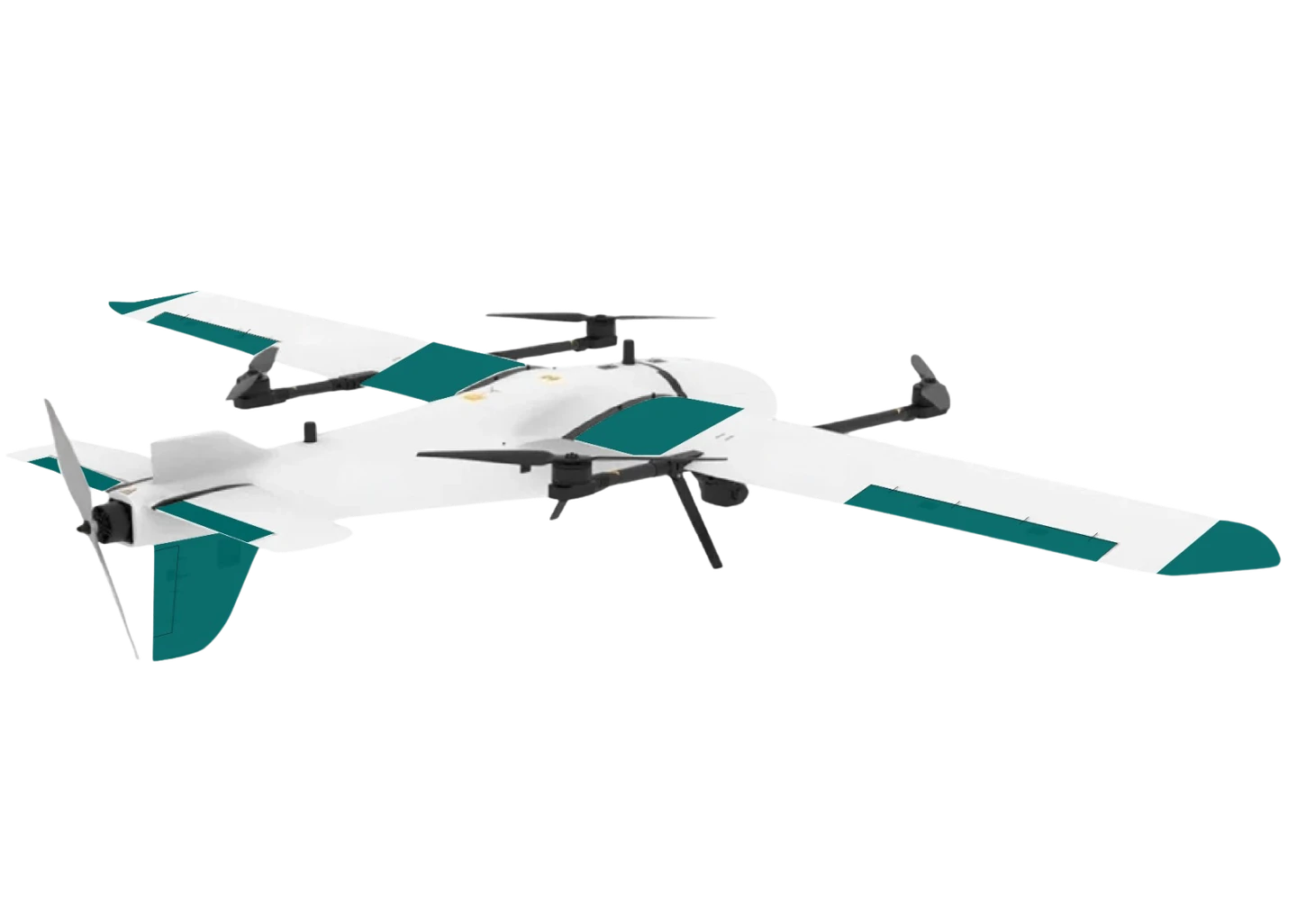
A brief need not be long, but it should include outputs, targets, extent, detail, accuracy, conditions, schedule, team support, and unknowns. Use it when discussing NiVO VTOL V2, V3, V5, V7, Agrios, and payload options. Request a configuration explanation and evidence plan tied to those needs. Where information is insufficient, arrange a focused trial or site review instead of forcing an early choice. The objective is not simply to own a particular aircraft, but to establish a workflow that delivers the information and evidence the project actually requires.
Illustrative case: replacing a model request with a testable project brief
Consider a hypothetical buyer who asks for a VTOL aircraft with every available sensor because several departments may use it. One department needs mapping, another needs close asset documentation, and another is exploring crop monitoring. The request contains no agreed target detail, positioning requirement, delivery schedule, or responsibility for processing. Rather than interpreting the equipment list as a complete specification, the consultation begins by separating the three decisions and their intended outputs. The team records representative targets, areas, site constraints, recipient roles, and unresolved questions without assuming that all payloads can operate together on every aircraft.
Each department then prepares a small acceptance example. The mapping example identifies the output and independent checks; the inspection example tests target readability and asset relocation; the crop example defines calibration and field-verification needs. The complete system review includes mounts, power, triggering, communication, data handling, training, and support. A larger specification is compared with a staged solution that first demonstrates the highest-priority workflow. Neither option is accepted because it contains more features. The comparison states confirmed capabilities, untested assumptions, and the evidence required before a promise can be made. Processing capacity and decision deadlines are reviewed alongside acquisition rather than assigned to an undefined future team.
Handover requires a brief that another technical reviewer can use to explain the proposed configuration, its acceptance criteria, and the next step for each unknown. If a site review or focused trial is needed, that becomes an explicit action rather than a hidden condition. The buyer receives a traceable reason for the recommendation and knows what could change it. This hypothetical scenario shows how consultation can produce a concrete, reviewable plan for useful information instead of merely selecting an impressive aircraft name and a long list of accessories.