Designing Drone Acceptance Tests for Mapping Projects
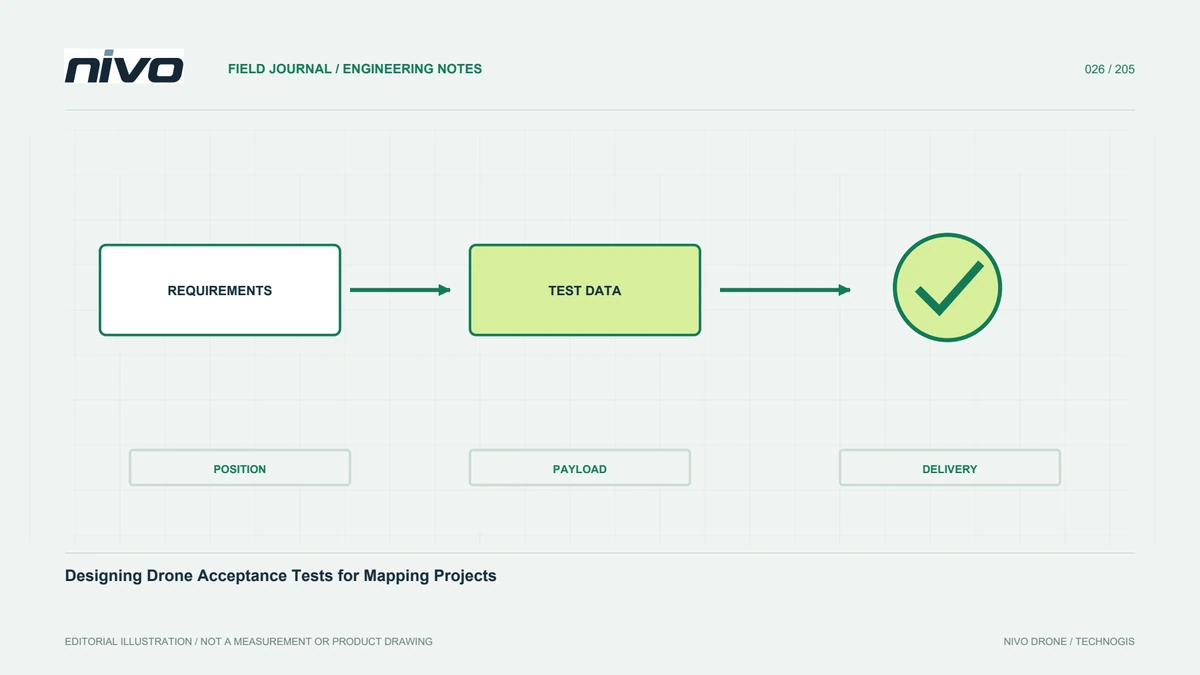
Define acceptance through project needs, actual configuration, sensor functions, complete data delivery, independent checkpoints, operator readiness, and documented findings.
Start with demonstrable requirements
Acceptance asks whether the supplied system meets agreed work needs. Be more specific than ready to fly or able to map large areas. Define outputs, configuration, data flow, training, and limits, then identify evidence. A requirement might concern delivering images and position records usable in an agreed workflow. Acceptance is not an opportunity to expand limits through unapproved experiments. Follow manuals, operating boundaries, and competent responsibilities. The resulting evidence should explain what is ready for use rather than allowing an impressive demonstration to substitute for project-specific proof.
Identify the tested configuration
Record aircraft, payload, mount, communications, battery arrangement, and relevant software. Mark changes during the process and review their effect on earlier evidence. One example does not accept every configuration in a family. Distinguish demonstration data from data generated by the actual delivered unit where relevant. Configuration documentation defines the acceptance scope and provides a future reference. Users can then recognise whether their current state remains equivalent or whether an added device, changed mount, or different firmware requires further review before older conclusions can be reused.
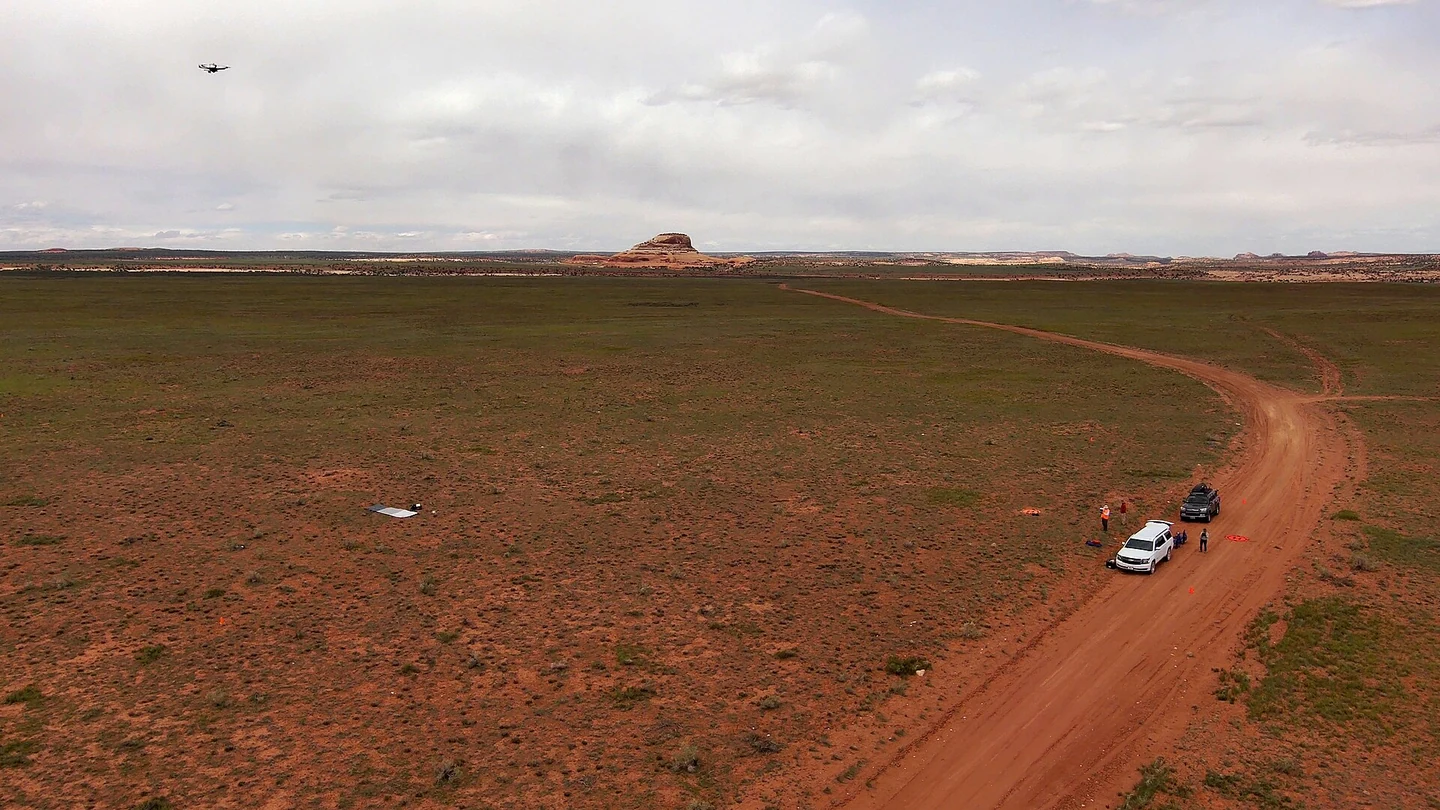
Choose a representative location
Select a site suited to objectives and approved procedures. Mapping tests should reflect relevant data needs without exceeding operating limits. State where the location does not represent the real project's terrain or access. Record assumptions and conditions. Site review still needs the responsible operator and coordination. A straightforward test with clear limits can be more useful than a complex demonstration lacking measurable relevance. Its purpose is answering the requirement, not maximising spectacle or producing a result that cannot be explained outside the demonstration setting.
Separate function from product quality
Recording successfully does not establish final output quality. Separate mechanical or interface checks, recording checks, and processed-product assessment. Define evidence for each. Triggering can be assessed through events and files, while an orthomosaic requires other checks. This division helps isolate unmet needs without declaring the entire system passed or failed from one observation. Conclusions can identify accepted functions, outstanding elements, and additional evidence. It supports targeted corrective work rather than repeating unrelated demonstrations that leave the original technical question unanswered.
Agree accuracy assessment in advance
Where accuracy is required, agree control and independent-checkpoint design, references, heights, and reporting before reviewing results. A position status or image resolution cannot replace product testing. Compared values must share suitable references. State limits if checks do not cover every area or project condition. Involve qualified survey and processing personnel. The purpose is understandable evidence rather than selecting whichever result comes closest to expectations. A clear method also prevents later disagreement about whether a supplied dataset actually addressed the requirement originally discussed.
Test the complete data handover
Use files genuinely produced during testing: original imagery, relevant positioning, events, logs, and configuration records. Have the processor run the intended project workflow. Record software, important choices, and missing information. Showing only a finished product does not establish traceability. A reviewable package supports repetition and technical assistance. It also demonstrates whether storage, naming, and management are understood by the people taking responsibility after handover. This part often reveals practical gaps that would remain invisible in an aircraft-only demonstration or a presentation of previously prepared maps.
Assess user and support readiness
Review training, manuals, reporting routes, and support responsibilities. Operators need configuration references and processors need the data package. A supplier demonstration alone does not prove the user's entire team is ready. Appropriate exercises can form part of agreed acceptance. Explain service limits and tasks still requiring integration. This prevents expectations expanding unnoticed when a user later tries a different sensor or job. Readiness evidence should connect the system with the people expected to sustain it, including any roles still needing assistance or further training.
Record findings and verify closure
List each finding, evidence, owner, and verification method. Distinguish document corrections, component replacement, configuration changes, and extra tests. Do not close an issue from verbal assurance alone. Where a change affects earlier results, define what needs retesting. Clear records let both parties see progress without reconstructing every discussion. They also prevent unfinished work disappearing as schedules or personnel change. The acceptance process should preserve visibility of outstanding limitations rather than treating delivery timing as evidence that every technical question has been resolved.
Finish with a usable acceptance package
Summarise scope, configuration, conditions, method, results, closed findings, and limits, with links to source data and operating material. Users should know which state was accepted and which future changes need review. This can begin the fleet configuration history rather than simply close procurement. The next project then has a reference for aircraft and data readiness. Good acceptance connects product promises with practical evidence and usable support, giving a defensible account of what the system can deliver for the agreed need and what remains outside the demonstrated scope.
Illustrative case: accepting evidence rather than a finished display
Consider a hypothetical acceptance meeting where a supplier presents a polished mapping output. The buyer appreciates the result but asks to trace it back to the actual tested configuration and source records. The agreed review separates aircraft and sensor functions, recording completeness, processing, independent quality checks, and user readiness. The processor attempts the intended workflow using the delivered files, while the operator verifies that the supplied manuals and configuration references describe the actual unit. If a required record is absent, the finding receives an owner and a verification method rather than being closed because the final image looks convincing. Any corrective change is assessed for its effect on earlier evidence. This is an illustrative procurement scenario, not a report about a real supplier or project. Its final package states what was tested, under which conditions, which findings were resolved, and what remains outside the demonstrated scope. The manager can then accept a clearly defined system rather than a general promise. Future assignments have a baseline for comparison, and technical support can determine whether a later question concerns the accepted arrangement or a new requirement that still needs integration and assessment.
The buyer may recognise a demonstrated part of the scope while keeping an unresolved function explicitly open, or require the complete agreed evidence before declaring the whole package ready. The acceptance record must state which conclusion is supported, without implying that a partial demonstration proves every promised capability. The handoff includes source-data identity, configuration, test conditions, assessment method, resolved findings, and remaining limits. The user can then plan from what is actually available. This final distinction makes procurement evidence useful beyond delivery day, because future reviewers can identify the accepted baseline rather than inherit an attractive presentation with undefined technical boundaries.