Operator Training and Team Briefings for VTOL Survey Work
Design training around the actual aircraft configuration, staff roles, site review, data readiness, shared communication, and evidence-based assessment of survey work.
Train for the actual work
Begin with the job and accepted aircraft configuration. General drone knowledge is useful but does not define a particular system. Identify operator, observer, equipment, and data roles, then connect competencies with manufacturer procedures and organisational processes. This article is about learning design, not a substitute for flight training or local qualifications. The objective is linking operation with survey results. Staff should understand not only their individual tasks but also the information another role needs before the overall process can produce a complete and useful deliverable.
Define responsibilities and decision boundaries
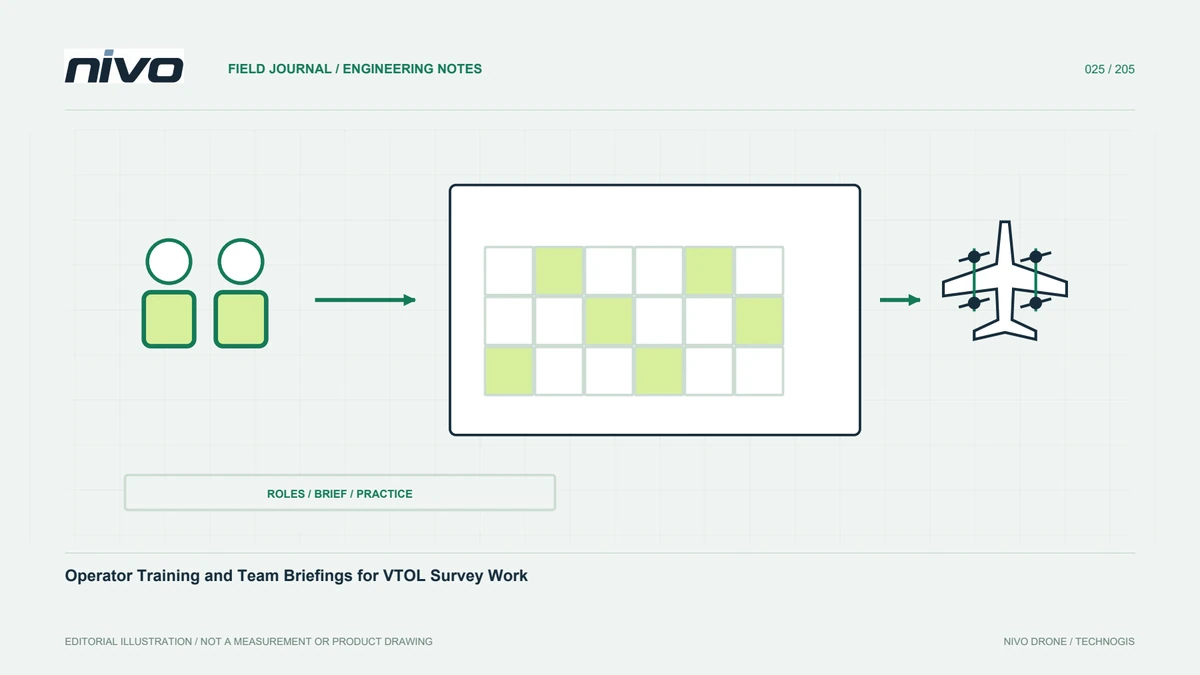
One person may hold several roles in a small team, but responsibilities must remain clear. Do not assume everyone knows who checks files, assesses the site, or controls mission changes. Use a work sequence to show handovers. Participants should know the follow-up path for findings. Clear roles keep field communication concise and expose missing support when staffing differs from the training example. The process should remain practical, while preventing a task being omitted because each participant assumed that someone else had completed it.
Use configuration documents as core material
Teach participants to find the correct manual, checklist, card, and records for the unit. Screenshots from another version may confuse terms or functions. Match material to the accepted state. Recognising equipment and mission identities matters as well as interface familiarity. Button memorisation is not sufficient competence. Staff should explain a support request and distinguish mission-planning questions from baseline-configuration questions. This knowledge reduces undocumented adjustments made in an attempt to solve a field issue and makes technical assistance more efficient when a genuine problem occurs.
Practise site and mission review
Use examples involving access, terrain, obstacles, and boundary differences. Discuss what maps establish and what still needs inspection. Connect the site with all relevant phases under the aircraft manual, not only the starting point. Review output requirements and tasks needing other viewpoints. Exercises should expose reasoning, assumptions, and change records. The aim is not one pattern for every site. Participants should understand how an approved plan is reviewed when actual conditions differ, and where operator or technical judgement is required before work proceeds.
Include data readiness as a skill
Teach required files, storage identity, image checks, timing relationships, and positioning inputs. Data work begins before flight because some observations must be configured in advance. A rehearsal handover lets participants see the consequence of unclear names or missing records. Use examples matching the real equipment. Assess the ability to deliver a complete understandable package, not just the image count. This connects the operator's work with processing and helps prevent successful-looking flights from producing incomplete evidence that cannot support the intended mapping method.
Make briefings establish shared understanding
Cover the objective, roles, conditions, configuration, and data plan using a common diagram or summary. The operator explains relevant procedure; observers and data staff contribute within their roles. Confirm shared terminology. Explicitly identify changes since initial planning and confirm review is complete. A briefing should not introduce unassessed equipment. Its purpose is ensuring everyone uses the same references and current understanding before work becomes busy. Save the relevant record so a later evaluation can distinguish the agreed plan from an assumption someone remembers differently.
Use scenarios to assess communication
Discuss realistic cases such as a mismatched storage identity or vehicle activity at the planned site. Qualified facilitators should keep exercises within the approved procedure. Assess information flow, responsibility, and documentation rather than improvising generic flight actions. Participants learn to state facts, consult references, and notify the correct decision-maker. This develops useful judgement without pretending an article or classroom discussion can establish aircraft-specific operating responses. Scenario outcomes can also reveal terms that need clarification before different staff are assigned to the same production team.
Assess through evidence
For mission management, participants can present a plan version and reasoning. For data, they can deliver an identified example package. For communication, assess whether reports provide enough context. Flight competencies require appropriate instructors and procedures. Record strengths and remaining training needs. Attendance at one session does not prove readiness for every role. Evidence supports realistic assignment and helps participants recognise when to seek assistance. It also gives the organisation a basis for refresher training after inactivity or after substantial configuration changes.
Continue learning after deployment
Feed repeated project findings, documentation problems, and communication gaps into training. Avoid turning every event into a longer checklist; select improvements with clear reasons. Update material and explain differences after configuration changes. Review readiness when staff return to an unfamiliar system. Continuous learning connects individual skill with the actual aircraft state. The goal is orderly survey work, clear data delivery, and accountable decisions by the right roles. Training then remains a maintained part of the service rather than a one-off event separated from the evidence generated during everyday field operations.
Illustrative case: rehearsing the handover between field roles
Imagine a hypothetical training exercise for a team whose members already understand the ground-station interface. Instead of repeating a button demonstration, the instructor presents a survey plan with an unresolved data-delivery requirement and a changed site-layout note. Participants must identify who owns each question, which reference applies, and what evidence is needed before the task can be treated as complete. The operator explains the accepted aircraft context without inventing a response outside the manual. The observer communicates the site change using shared terminology. The data lead checks a representative file package and identifies missing information without assuming it can be recovered later. The exercise is evaluated through the quality of those handovers, not through attendance or confidence alone. This scenario is explicitly illustrative and does not describe a live operation. Its result is a record of demonstrated responsibilities and remaining training needs. The manager can assign follow-up learning to the relevant role rather than sending the whole group through unrelated material. The revised briefing format also preserves what changed and who confirmed it, giving future teams a practical way to establish shared understanding before field work begins.
Targeted practice on the weak handover may be more useful than repeating an entire introductory course, while a broader refresher may be justified if the configuration knowledge itself is incomplete. The instructor chooses from demonstrated evidence rather than confidence or seniority. The handoff records the scenario, expected responsibilities, observed gaps, and the follow-up assessment. Updated briefing material identifies the current configuration and the references participants must find. Acceptance of readiness is therefore linked to the actual role and task. This helps a manager assign work realistically without presenting attendance as proof that every participant can perform every responsibility.