Drone Inspection of Power Networks: Asset Records and Targeted Observation
Plan power-network documentation through asset identities, readable RGB and thermal evidence, owner coordination, component-based coverage, and qualified technical follow-up.
Agree scope with the network owner
Begin with the owner's needs and applicable site procedures. Define visual documentation, thermal-pattern review, inventory, or post-event observation separately because they need different evidence. Prepare asset lists, location identities, known operating conditions, and tasks requiring another technical method. Aircraft operators and electrical examiners have different responsibilities and should understand both roles. A clear plan collects images for the right questions while leaving condition judgments and interventions with authorized personnel familiar with the network rather than extending aerial observations into unsupported conclusions.
Establish asset identity before capture
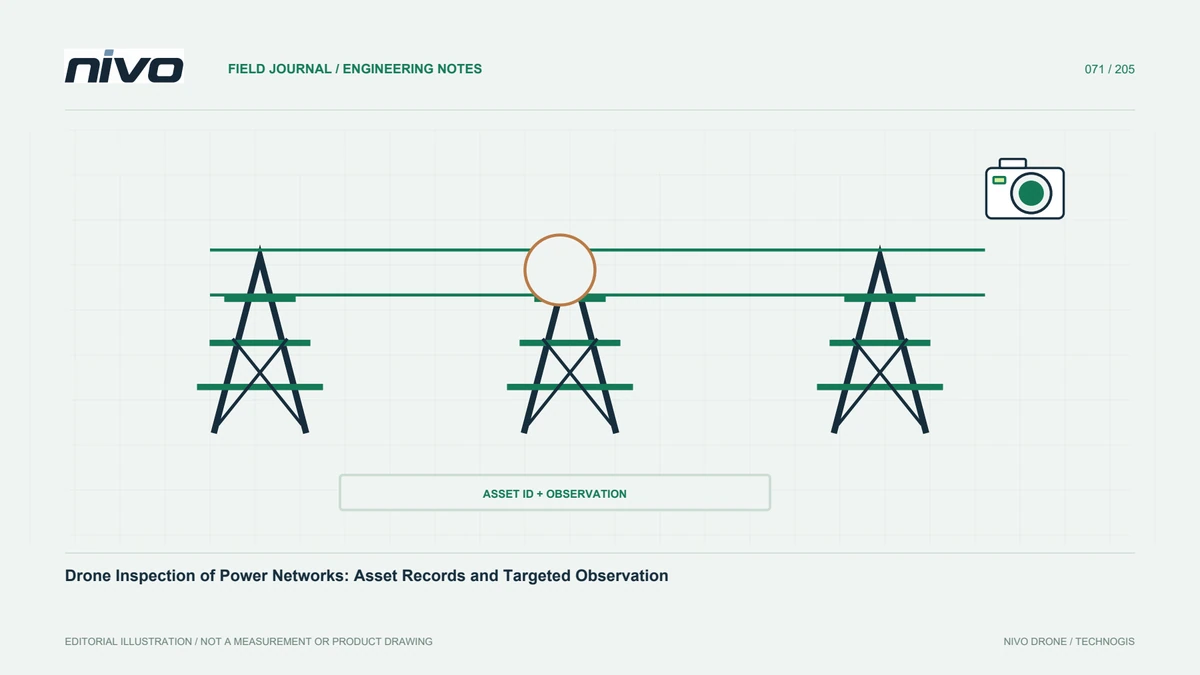
Poles, towers, spans, and components can look similar. Use the owner's identifiers where available and connect them with the work map. Findings need asset, side or view, date, and locating context. A close component image is difficult to action if its location exists only in operator memory. Link overall and detail views through a stable register. Explain positional uncertainty and other relocation information where needed. Consistent identities also connect repeated inspections with earlier findings and the owner's maintenance history.
Specify the RGB detail required
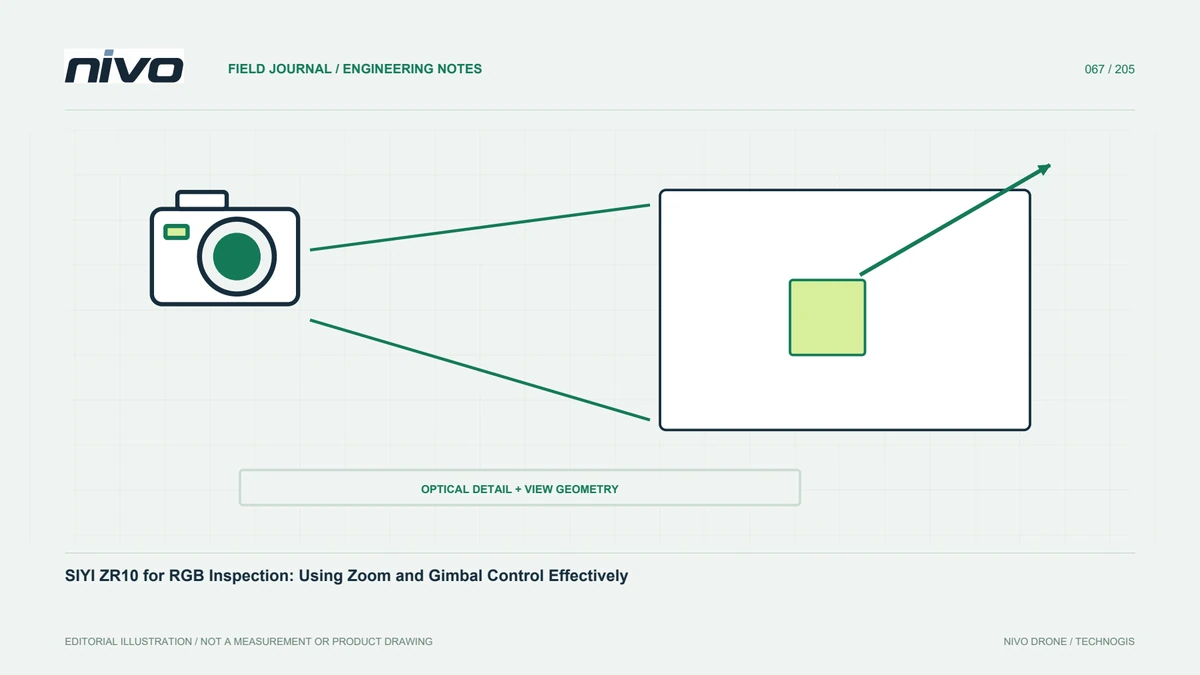
RGB can document shape, surfaces, unusual parts, and surroundings, but readable detail depends on geometry, optics, light, and sharpness. Test representative targets with the examiner. Digital enlargement does not replace uncaptured information. With a gimbal camera, verify direction and zoom control without losing context. Position and distance must follow the operator's assessment and owner requirements, not merely the wish for a larger target. Accepted examples help the team maintain a practical image standard consistently across different parts of the inspection route.
Read thermal patterns with operating context
Equipment patterns depend on surface state, operation, and surroundings. Obtain relevant information from the owner before interpreting differences. Similar components may have different loads or materials. Where the data support only relative screening, report a finding for review rather than confirmed failure. Consider reflection and viewing angle, retaining RGB evidence that identifies the component. Further electrical assessment needs suitable personnel and methods. Aerial images should enter that process as traceable observations with explicit conditions, not as a substitute for technical verification of the system.
Coordinate routes and observation boundaries
Work around electrical networks requires a site-specific review and appropriate coordination. Understand obstructions, access, communications, restricted areas, and stop conditions. Do not derive operating distances from a general article or assume every network has identical requirements. The plan belongs within the relevant owner and operator process. Separate the examiner's need for detail from the pilot's responsibility for positioning. Record areas that cannot be adequately viewed for another method. Honest incompleteness is more useful than forcing a photograph without a suitable operational basis.
Control completeness by component
A coverage register should show assets or component groups with adequate evidence. A completed route does not prove every target was clearly seen. Check occlusion, changing light, and unsuccessful viewpoints. Review representative files and identities after each block before moving farther away. Mark repeats with their reasons. Asset-based completion reduces unnecessary duplication while exposing missing documentation. The work is complete when agreed inspection needs are met, not merely when a certain route length or image count has been achieved by the aircraft.
Distinguish observation, hypothesis, and verification
State directly visible facts first, such as a differing pattern in a relevant component comparison. Separate causes and system-condition conclusions. Record additional investigations for authorized personnel where needed. Do not use confirmed-damage language for preliminary observations. Include known operating circumstances and important unknowns. This supports prioritization without false certainty. After verification, update status while retaining the initial evidence, preserving an understandable history of how the finding progressed from aerial observation to a technical interpretation and subsequent action.
Connect outputs with maintenance work
Provide asset identity, location, time, context, detail, conditions, and verification status. Explain priorities agreed with technical personnel and separate them from unconfirmed severity. Use a register that can be updated after investigation or action, connecting it to asset-management processes where available. Outputs need not be elaborate, but images must remain linked to real tasks. This makes it possible to assess whether aerial work improves inspection priorities and condition history rather than simply generating another archive of unconnected photographs.
Review configuration and follow-up quality
Acceptance should test target relocation and finding closure as well as image appearance. Use representative network tasks. Discuss RGB, thermal, gimbal, controls, outputs, and suitable aircraft configuration when considering NiVO. Integration and procedures must establish suitability; a product list alone cannot. After delivery, review ambiguous findings, incomplete coverage, and verification outcomes. Use that evidence to improve future routes and documentation so that drone inspection supports measurable maintenance work while retaining the boundaries of what aerial visual observation can establish.
Illustrative case: a thermal comparison with missing operating context
Consider a hypothetical power-network inspection comparing apparently similar components. One appears different in the thermal view, and an initial note labels it as a confirmed fault. The technical reviewer asks whether the components were operating under comparable circumstances and whether reflective surfaces or viewing geometry could influence the observation. That information is absent from the record. The team retains the anomaly as a review item but withdraws the unsupported diagnosis. It requests relevant operating context from the asset owner without attempting electrical intervention or using a general article to define site operating distances.
The owner and qualified personnel determine what additional assessment is appropriate. The aerial team supplies paired RGB evidence, stable asset identity, acquisition time, known conditions, and explicit unknowns. If another observation is useful, it is planned through the site's approved process rather than improvised to obtain a closer-looking image. The coverage register distinguishes components with adequate evidence from those obstructed or incompletely documented. Findings remain linked to original files, and the report separates visual facts, proposed explanations, and confirmed outcomes. A change in interpretation does not erase the initial observation or its place in the inspection history.
The next-step discussion compares a bounded screening alert with a technically supported condition conclusion. The first can guide attention without pretending to be the second. Handover requires a reviewer to relocate the component, understand why it was selected, identify missing context, and assign the appropriate follow-up responsibility. A technician not involved in the flight tests that sequence. This hypothetical scenario shows how useful aerial inspection depends on coordination and traceable evidence, while electrical judgments and interventions remain with authorized personnel and methods suited to the actual network.