Writing Drone Inspection Reports That Support Practical Follow-Up
Turn inspection photographs into usable reports through asset identities, locating context, evidence levels, verification status, coverage limits, and documented next actions.
Start with the recipient's next task
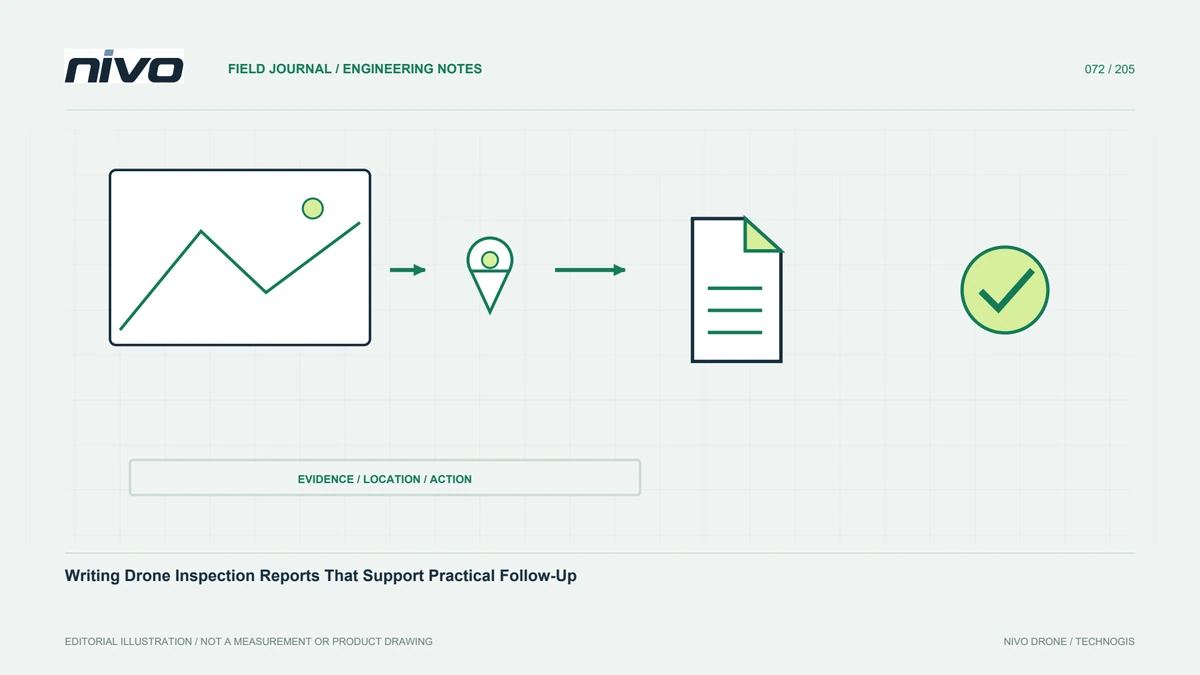
A useful report tells the recipient which part needs review and why. Before acquisition, ask who reads it, how assets are located, and what follow-up process is used. Technicians, facility managers, and management may need different detail. Do not postpone report design until flying ends. Reporting requirements determine context photographs, naming, conditions, and supporting information. This produces connected evidence rather than many sharp images whose location or significance remains unclear to anyone who did not participate in the original fieldwork.
Give assets and findings stable identities
Use official asset numbers where available and keep finding identities unchanged through follow-up. One asset may have several findings, while one finding can require multiple photographs. The register should show those relationships without depending on folder order. Include layout position, direction, date, and relocation details. Identity matters as much as sharpness where components repeat. Do not renumber findings when status changes because that can break history. A consistent simple system is preferable to elaborate naming that neither operators nor recipients actually understand.
Separate observed facts from interpretation
Begin with what the evidence visibly supports, then add interpretation where the technical basis exists. A thermal difference, changed shape, or unusual surface is an observation. Cause, severity, and performance effects may require verification. A finding title should not imply more certainty than its evidence. Label provisional explanations and identify missing information. This distinction tells recipients what is demonstrated and what still needs investigation. The report becomes a guide to the next decision rather than a collection of conclusions whose relationship to the source images is difficult to reconstruct.
Pair locating views with detail
Detail shows the condition; context shows where to find it. Include both with clear links. For thermal and RGB work, check that paired files show the same component, accounting for differing fields of view. Annotations should not conceal information, and unmarked originals must remain available. Avoid crops that remove the asset relationship. Explain display processing where it affects interpretation. A reviewer should be able to trace the report illustration back to its source rather than depending on a small picture modified repeatedly during presentation.
Record conditions that influence meaning
Date, time, weather, asset operation, viewing direction, and camera configuration can help explain appearance. Choose metadata relevant to the inspection instead of collecting unused fields. Thermal interpretation may depend on operation and surroundings; RGB readability may depend on light, shadows, and sharpness. State important unknowns. These records also support later comparisons, preventing a changed view from being mistaken for physical deterioration. Sufficient context helps technicians decide when existing evidence is useful and when another observation under more suitable circumstances is required.
Distinguish status from priority
Status can identify a newly recorded finding, one awaiting verification, or one already investigated or resolved. Priority is different and should be agreed with people who understand the asset. A red symbol must not silently mean severe damage when evidence does not establish it. Explain criteria and authority. If a rating is provisional, give its rationale and review requirement. Keep earlier records when judgments change. Separating status and priority supports a workable maintenance queue while preserving the reasoning behind the actions selected at each stage.
State coverage and unobserved areas
Identify the assets actually examined, acquisition method, and parts lacking adequate views. Obstructions, light, geometry, or operational limits can leave gaps. A visual model is not a substitute for missing observation. Specify where another method is required. Coverage statements prevent the assumption that no finding means the entire asset has been proven sound. This is especially important in repeated work: managers must distinguish adequately observed areas without unusual patterns from areas that have not yet received evidence of the required quality.
Connect recommendations to a next step
Recommend an investigation or review appropriate to the evidence instead of jumping to an unverified repair. Identify the recipient, information required, and status-update process. Technical interventions belong to authorized personnel familiar with the system. Operators can explain image origin and conditions without assuming every assessment responsibility. Use a concise register linking each finding to responsibility and completion evidence. The report can then evolve as a working document, showing which issues are understood and which still require further investigation before a defensible decision can be made.
Test readability before handover
Ask someone absent from acquisition to locate an asset and understand a sample finding. If they must guess or ask how files relate, improve context and structure. Check identities, links, legends, units, and verification status. Archive originals and change notes with the report. After recipients use it, collect feedback about helpful and confusing parts and adjust future capture accordingly. Report quality is not page count; it is the ability to connect aerial evidence with location, condition understanding, and a suitable traceable action.
Illustrative case: a report that cannot become a maintenance task
Imagine a hypothetical inspection report containing many detailed photographs and a list of red, amber, and green findings. The maintenance coordinator cannot use it because the colors mix urgency, evidence confidence, and completion status, while several asset names differ from the owner's register. The team does not respond by adding more photographs or making the cover more elaborate. Instead, it asks the coordinator to walk through one finding and explain the information needed to create a work item. That exercise reveals where the report's apparently comprehensive presentation fails to support a practical next decision.
The revised structure separates asset identity, observed fact, provisional interpretation, priority basis, verification status, and assigned follow-up. Overview and detail images remain linked to originals. A statement of unobserved areas prevents the absence of a finding from being read as complete clearance. The report also preserves acquisition conditions relevant to interpreting each observation. When later review changes a diagnosis, the initial record is retained and linked to the update rather than overwritten. The same stable finding number continues through the maintenance process, keeping the relationship between evidence, decisions, and completed actions understandable across different teams and dates.
The handover compares a static photo archive with an actionable inspection register. Either may be a valid deliverable, but their acceptance criteria are different and must be agreed. For the register, a colleague absent from the flight must locate the asset, retrieve evidence, distinguish a hypothesis from confirmation, and identify the next responsible role without asking the pilot to reconstruct the story. This hypothetical example shows why report quality depends on decision clarity and traceability, not page count, color density, or the visual impact of individual photographs.