Planning Recoverable Backup and Storage for Drone Survey Data
Protect original imagery, trajectories, control records, and outputs through separate copies, manifests, version control, access rules, and tested recovery procedures.
Design backup around recovery
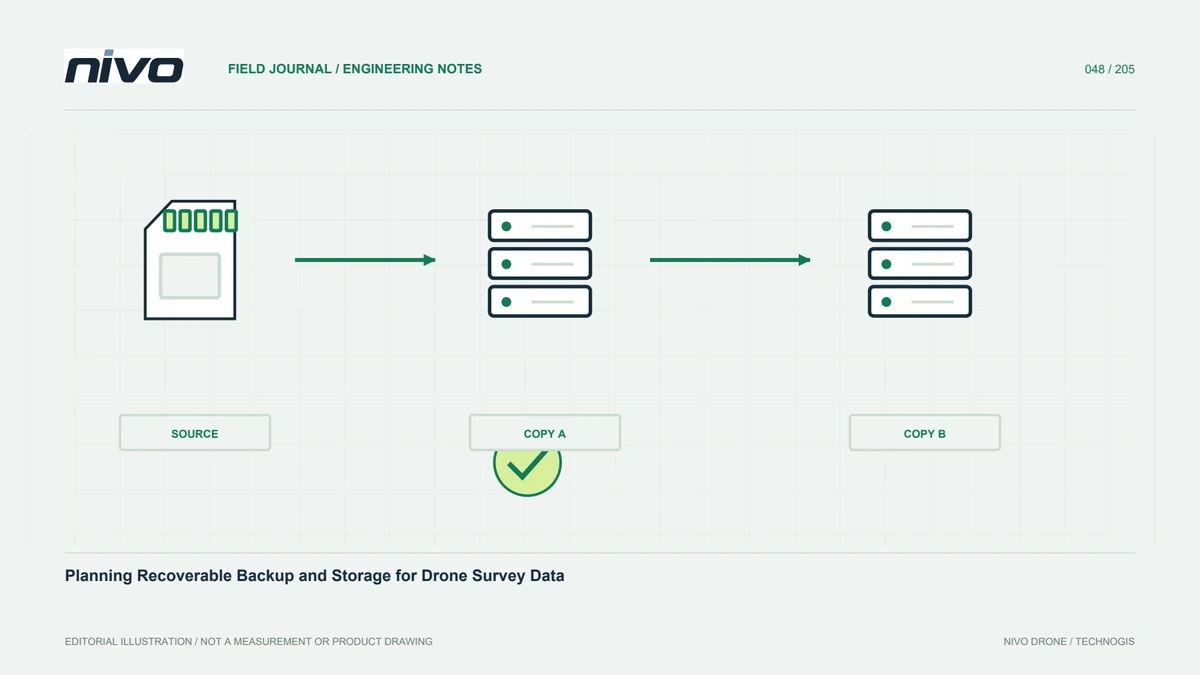
Two folders do not necessarily provide resilient protection. If both reside on one device or synchronise without useful history, a failure or deletion may affect both. Define what must be recovered, who is responsible, and the acceptable amount of lost work. Repeating a drone survey may be difficult because access, weather, or site conditions have changed. Prioritise sources and records that cannot readily be recreated. Start with an inventory and a verification process. The objective is restoring a complete, usable project, not merely seeing that a copying operation finished or that an online service currently lists the files.
Separate irreplaceable sources from reproducible outputs
Original images, sensor records, trajectories, control measurements, and field notes differ in value from temporary processing files. Protect sources from accidental overwrite and keep working outputs separately. If conversion or correction is needed, preserve originals and a change record. Use consistent project, block, and session identities. Do not leave the sole control-coordinate copy inside one person's application without an accessible export. This inventory helps prioritise limited capacity, giving the hardest-to-replace observations protection before temporary files that can be regenerated from complete inputs and sufficiently documented processing settings.
Separate copies by their risks
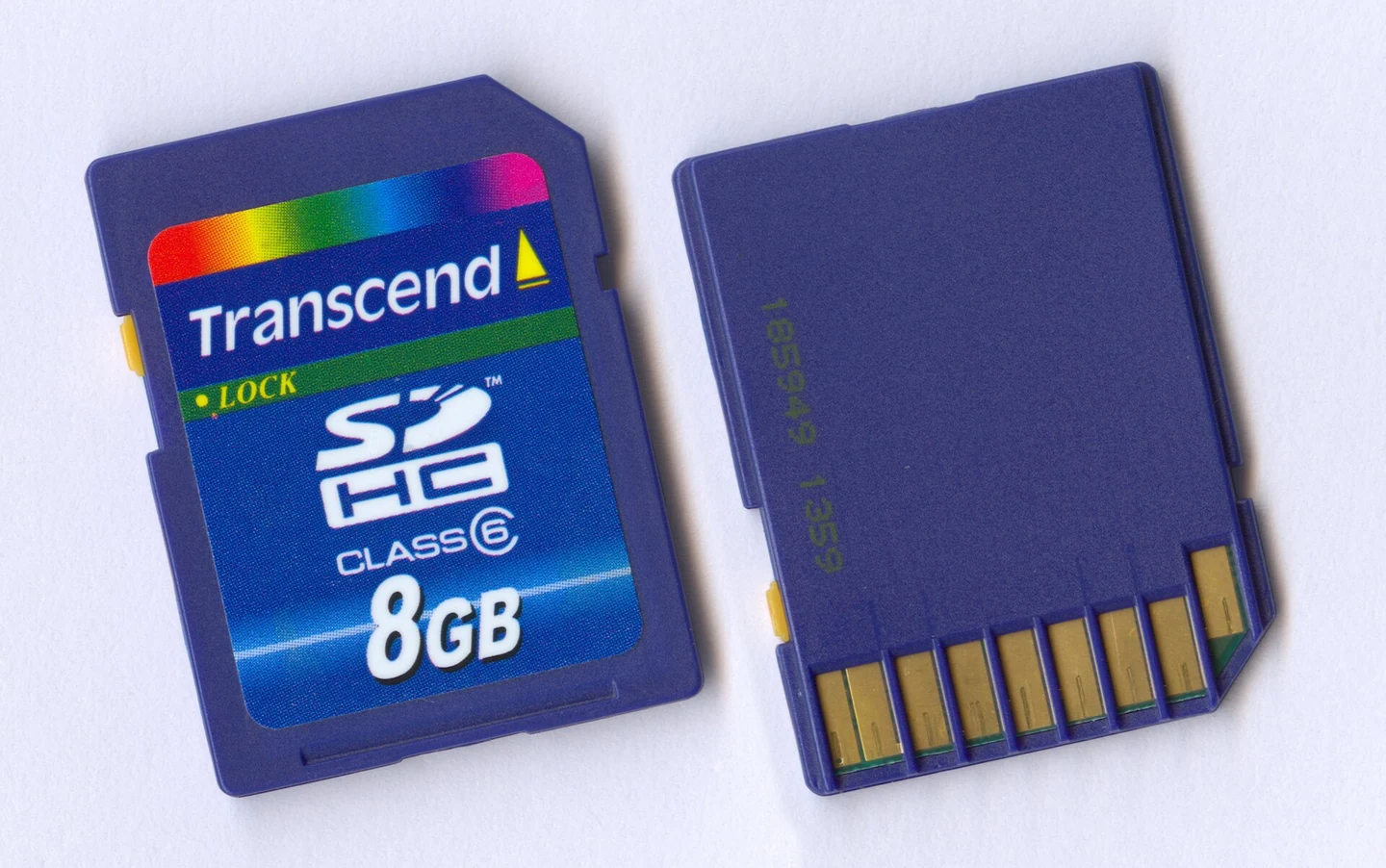
Maintain copies on media or locations that do not share every failure mode. The arrangement may include working storage, separate storage, and another location according to project policy. Consider loss, device failure, human mistakes, and service disruption. Synchronisation alone is not a complete backup strategy: understand deletion propagation, revision history, and recovery in the chosen service. Record copy locations and responsible access holders. Risk separation is about whether one incident can affect everything required to restore work, not simply a device count or a reassuring appearance of duplication within the same storage environment.
Verify transfers with a manifest
A manifest can record names, sizes, session identities, and checksums where used. Compare copies against it to identify missing or changed content. Equal file counts are not sufficient because different collections can contain the same number of files. Test representative images and sensor inputs after transfer, retaining the verification record. Before reusing a memory card, complete the project's copy-acceptance procedure. This reduces reliance on an operator's memory and supports investigation if processing later reveals an unreadable file. Verification should cover the actual copied data, not only a successful message from the transfer application.
Preserve output versions and context together
Quality review can revise products, so versions need explicit identities. Keep relationships between outputs, settings, sources, and reports. Do not silently overwrite results already used for decisions. Include metadata, GIS projects, styling, and control documents where needed to understand or repeat the work. Data can be physically recovered yet remain difficult to use without context. Test relative links after moving a project. A useful backup restores workflow and meaning rather than a directory of large files requiring the team to reconstruct how everything fits together from scattered memories and uncertain filenames.
Set access for actual responsibilities
Survey data may contain locations or assets not intended for public distribution. Follow agreed project rules for storage, sharing, and access. Distinguish permission to read sources, modify working outputs, and approve deliverables. Avoid giving every user unrestricted modification rights where that increases accidental-loss risk. Record ownership and management contacts so access does not depend on one person. Use external services only within project approval and storage requirements. Recovery planning should preserve availability without unnecessarily exposing data to people who do not need it or making the only usable copy dependent on an unavailable account holder.
Practise restoration before an incident
Restore a sample to a separate location without disturbing active work. Check source readability, project opening, metadata, and important products. Record recovery time and manual dependencies. Test a scenario where the main workstation is unavailable, since paths or access details may exist only there. Use findings to improve structure and instructions. An untested backup carries uncertainty that is hard to assess. A recovery exercise demonstrates whether designated staff can carry out the procedure, instead of assuming that the person who originally configured it will always be present when an urgent restoration is needed.
Define retention and project closure
Agree which material is retained, for how long, and who can authorise closure or removal under project policy. Distinguish operational, contractual, and archival needs without inventing legal obligations. After handover, retain an index of accepted products and package checks. Before clearing temporary work, verify that necessary sources and reproducibility settings remain. Record archive relocations when devices change. An explicit retention plan controls capacity while protecting valuable evidence. Otherwise, teams risk either deleting too early or keeping every temporary file indefinitely without a defined purpose, owner, or practical route for finding the relevant version later.
A daily field-team workflow
After capture, copy inputs into an identified session, produce a manifest, and verify separate storage under the agreed procedure. Processors receive sources with field context, while an archive copy remains distinct from the working folder. Revised outputs enter handover only with clear status and metadata. Periodically restore a sample. NiVO payload choices change file sizes and input types, but the management principles remain the same. Routine evidence of copying and recovery makes preservation part of production, giving the team a practical basis for showing that collected observations can be found and restored when needed.
Illustrative scenario: copies exist but a project cannot be restored
Imagine a hypothetical field team that has copied images into two folders on one portable drive. Both folders appear complete, and the memory card is about to be reused. A coordinator asks the team to demonstrate recovery rather than rely on the visual presence of duplicate names. The inventory includes imagery, sensor records, control coordinates, field notes, and the metadata needed to understand the session. The team checks the copies against a manifest and tests representative files. It recognises that two directories on the same device do not provide meaningful separation from every device-loss or media-failure risk.
The team compares additional storage arrangements under the project's actual access and retention rules. A separate verified copy is established in an approved location, with responsibilities recorded. Synchronisation behaviour is reviewed so deletion propagation is not mistaken for protected history. The test then restores a sample project into another location without disturbing active work. Files open, relevant links work, and required source records can be found without the original workstation. If a processing setting or reference description exists only in one person's application, the recovery exercise identifies that gap before the sole field source is released for reuse.
The closure record explains which checks were completed and who can recover the approved package if the main equipment is unavailable. Temporary files and irreplaceable observations have different retention decisions rather than being treated as one undifferentiated folder. This hypothetical case shows how backup becomes useful through verified content, separated risks, preserved context, and a tested restoration process. It does not claim that any storage arrangement removes all risk. Instead, it gives the team evidence that the information necessary to repeat or understand the survey remains accessible under the situations considered in its plan.