Payload Startup Power and Unexpected Controller Resets
Investigate startup-related resets through supply topology, timing, monitor locations, device requirements, and controlled verification of the installed power system.
Establish the sequence before assigning a cause
A reset occurring near camera or sensor startup deserves a precise event record. Identify which device restarted, which remained powered, and how the observation was detected. A lost ground-station connection is not by itself proof the flight controller rebooted. Preserve available logs, status messages, and operator notes. The first task is distinguishing an actual power or startup event from communication or application behavior that only appears similar.
Draw the complete supply arrangement
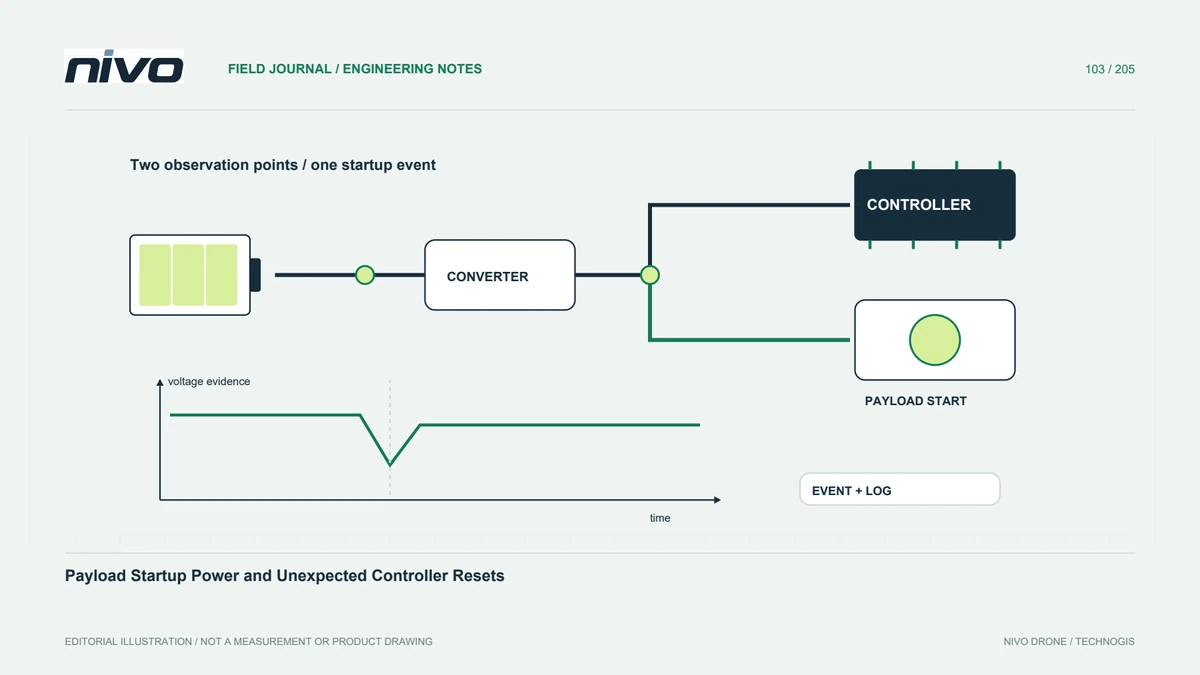
Map batteries, converters, distribution points, protective devices, connectors, and the loads they supply. Identify shared paths and the locations monitored by recorded voltage channels. A healthy battery reading does not establish the voltage at every device input. Record the exact installed components and recent additions. This diagram helps reviewers ask focused questions about the system instead of treating every startup-related symptom as a faulty battery or camera.
Review device requirements and startup behavior
Use official documentation for the actual payload and supply components, including startup and operating requirements where specified. Nominal steady-state consumption is not the whole design question. Do not assume a spare output can power another device because the connector fits or the average demand seems small. The integration assessment should consider the complete approved arrangement and its margins without inventing a universal converter size or wiring prescription.
Match measurements to the event
A brief supply disturbance may not be visible in a slow recorded channel. Identify sampling characteristics, measurement location, and timestamp relationships before interpreting a flat trace as proof of stability. Competent personnel should determine suitable instrumentation and permitted tests. Do not probe powered equipment or bypass protection based on a general article. Preserve the event and measurement method so conclusions remain linked to what was actually observed.
Assess changes as a system
If a supply correction is proposed, review electrical compatibility, grounding, mechanical retention, thermal behavior, and effects on other connected devices. Changing several parts simultaneously can make the result hard to explain. Keep the baseline and verify the actual installed configuration through the aircraft's technical process. A successful single startup does not demonstrate repeatable behavior across every relevant condition or approve a previously unvalidated power arrangement.
Document a repeatable startup reference
The accepted record should identify equipment, supply topology, authorized startup sequence, test evidence, and conditions requiring further review. Link it to payload and aircraft configuration so later additions trigger an appropriate assessment. This supports NiVO integration planning while preserving the distinction between a plausible power hypothesis and an established cause. Operators receive a documented arrangement and escalation route rather than an improvised workaround for unexplained resets.