Readback Communication for Drone Field Teams
Design clear field exchanges through shared location identities, explicit roles, confirmation of important information, and practice tied to the actual operating procedure.
Identify exchanges where misunderstanding changes a decision
Not every field conversation needs a formal confirmation loop. Focus on information that changes readiness, location availability, mission selection, or an agreed operational response. Define those exchanges within the team's approved procedures. This gives readback a practical purpose instead of adding ritual words to every message. The aim is to establish that the receiver understood the relevant meaning and that the sender noticed any discrepancy before the team acts on an assumption.
Use shared names for places and equipment
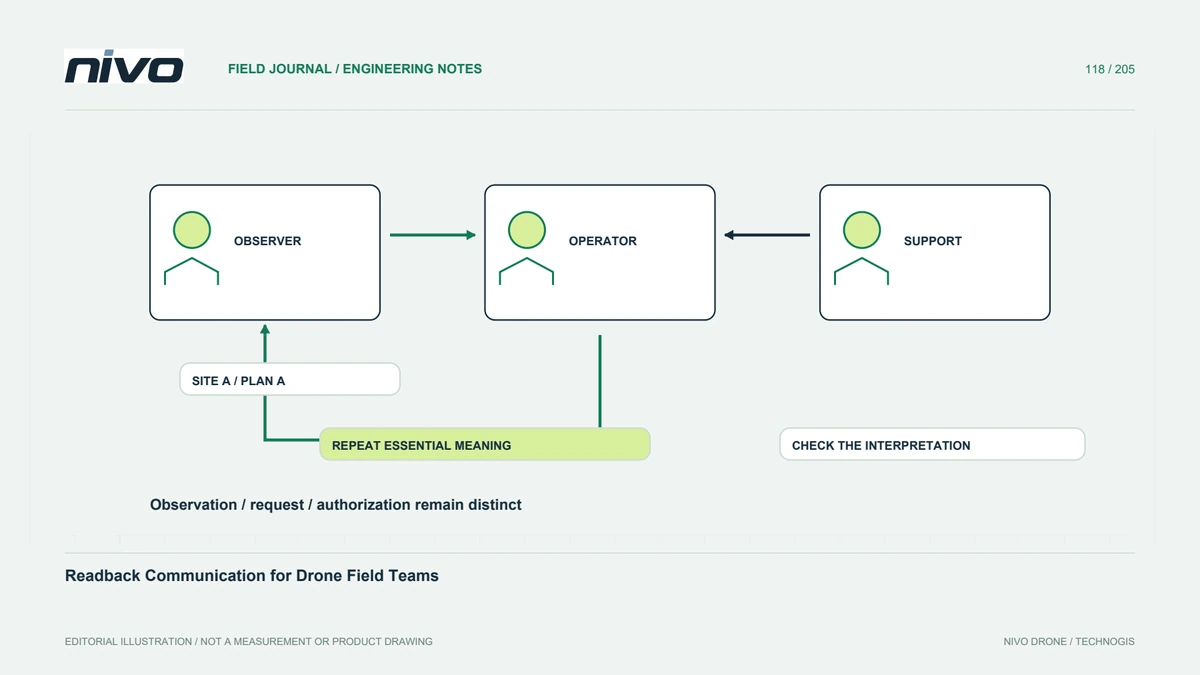
A message about the other field, the small battery, or the latest plan can be ambiguous. Use location, aircraft, payload, and mission identities already visible in the working records. Brief pronunciation or labeling issues before the operation. A common naming system reduces the amount that must be reconstructed from context. It also helps another team member recognize when a report refers to the wrong site or an obsolete configuration.

Separate observation, request, and authorization
A person reporting a changed condition is not necessarily issuing an aircraft command. A request is not automatically an authorization. Make those roles clear in the actual procedure and training examples. State the location, observed condition, and relevant timing without adding unsupported causes. The responsible operator retains the documented decision role. This separation helps important information reach the correct person without allowing a conversational acknowledgment to be mistaken for approval to proceed.
Close the loop on the meaning
For selected exchanges, the receiver repeats the essential information in an agreed concise form, and the sender checks that interpretation. Resolve differences explicitly rather than assume silence means agreement. A confirmation should identify the relevant object and action or status, not merely repeat a vague word such as ready. Keep the method proportionate to workload. Generic aviation communication guidance informs the design, while the team's approved procedure defines its actual application.
Practise ambiguity before field deployment
Use clearly hypothetical exercises involving similar site names, changed mission versions, or incomplete readiness reports. Assess whether participants detect the ambiguity and identify who must resolve it. Do not reward speed alone. Review how interruptions, poor audio, and competing tasks affect understanding without inventing unsafe live demonstrations. Training should produce practical examples and corrections that match the team's equipment, responsibilities, language, and communication arrangements.
Review exchanges as part of learning
After the task, discuss misunderstandings using relevant records and participant accounts. Separate the observed exchange from assumptions about intent. Improve naming, role definitions, or phrase structure where evidence shows a problem. This supports NiVO field coordination without claiming that a scripted phrase replaces competence or supervision. Useful readback preserves decision clarity and provides a way to catch a specific misunderstanding before it becomes an unexplained operational disagreement.