Planning Roof Thermal Observations Around Heating and Weather History
Design roof thermal timing from the building question, material history, prior heating, moisture context, and verification method instead of a universal flight-hour rule.
Begin with the roof question
Thermal roof observations need a defined purpose and a building examiner who understands the relevant method. Investigating a surface pattern differs from proving hidden moisture or identifying a leak source. Establish the roof construction information available and what further testing may be required. FLIR's airborne roof examples provide context for this application, but they do not make every aerial thermal image a complete diagnostic roof survey or eliminate the need for local technical judgment.
Collect the history that affects timing
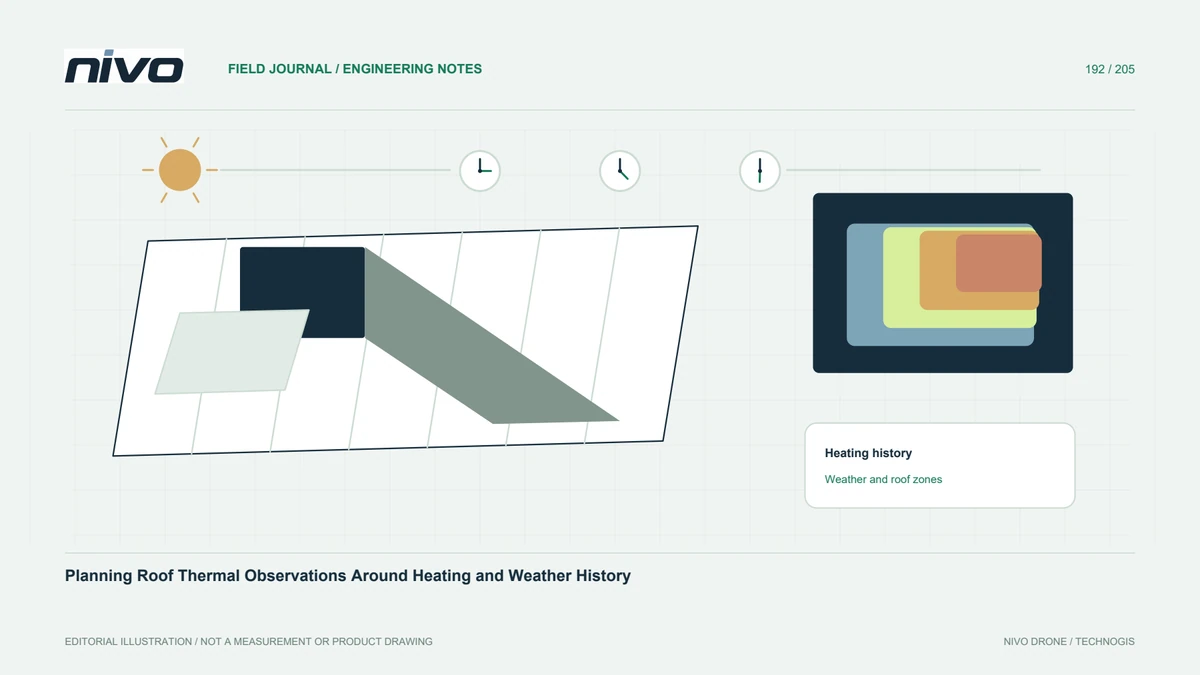
Record recent weather, surface wetting, sunlight and shade, known repairs, and relevant building operation. A roof's appearance at capture reflects more than the clock time. Different materials and assemblies may respond differently to prior heating. Ask the examiner which conditions are needed for the specific question. Do not copy a convenient flight hour from another project and assume it creates an equivalent observation opportunity for a different roof, climate, or season.
Plan zones with different histories
Divide the roof into meaningful areas where material, shade, equipment, repair history, or exposure differs. A rooftop structure can create a different heating history on adjacent surfaces. Keep these distinctions in the observation plan and report. An unusual pattern at a zone boundary may need contextual explanation before interpretation. Avoid presenting all roof pixels as if they had experienced identical conditions simply because they were captured during the same flight.
Trial the observation opportunity
Capture representative evidence under the proposed conditions and have the qualified examiner review original files. Record which features can be read and whether the pattern supports the intended investigation. If conditions are unsuitable, revise timing or scope through the responsible process. Do not compensate for an uninformative observation by selecting a more dramatic palette. A trial should establish a useful evidence opportunity, not just demonstrate that the camera can display a contrast-rich roof image.
Preserve alternative explanations
Pair thermal findings with RGB context, roof-zone identities, and acquisition notes. Consider material changes, reflections, shadow, repairs, and other relevant circumstances. Keep suspected causes provisional until supported by the examiner's verification method. A repeated pattern can help direct attention without proving moisture, insulation failure, or a leak location. The record should state what additional evidence would resolve the question and distinguish an inconclusive observation from a confirmed absence of a problem.
Deliver conditions with the finding
Provide timing rationale, weather and heating context, source files, observed coverage, and follow-up requirements. A later reviewer should understand why the chosen window was considered relevant and where that assumption remained uncertain. Use representative roof examples during NiVO thermal-payload consultation and acceptance. The useful result is a bounded, repeatable observation plan tied to the building question, rather than a universal timetable or a promise that one aerial visit replaces every other roof-assessment method.