Building a Repeat-View Library for Drone Asset Inspections
Create reference-view records with stable component identities, context, capture conditions, source links, and explicit limits so later inspections can compare evidence fairly.
Choose views that serve a question
A repeat-view library should support defined observations, not accumulate every photograph from every visit. Select asset areas where comparable documentation will help future review. Identify what must remain visible and why. A general overview, connection detail, and thermal observation may each need a different reference. The library should explain the intended use of a view so a later team can decide whether a new observation is comparable or needs a different method.
Give each reference a stable identity
Connect the view to the owner's asset and component register, with side, level, sector, or another understandable location reference. Keep the reference identity stable even when the file or finding status changes. Store an uncropped locating image beside the detail. Repeated structures can look alike, so a filename based only on date is inadequate. Another operator should be able to identify the target without relying on the memory of the original photographer.
Record useful capture circumstances
Keep camera and lens configuration, relevant zoom, orientation context, date, light, and important asset conditions. Record available geometric information without implying that every installation provides accurate camera-position metadata. For thermal work, retain the conditions and data status needed for the agreed interpretation. A reference image is not a command to reproduce an old aircraft position unconditionally. The responsible operator must assess the current site and determine how to obtain suitable evidence within applicable procedures.
Review appearance before declaring change
Compare original images at an understandable scale and inspect differences in viewpoint, shadow, wetness, rendering, and target visibility. A surface may look altered without physical deterioration. Where geometry or lighting is too different, mark the comparison limit instead of forcing a before-and-after conclusion. Keep contradictory views and field-verification outcomes. The library should help explain change, including cases where the available evidence cannot establish whether the asset itself has changed.
Version the reference deliberately
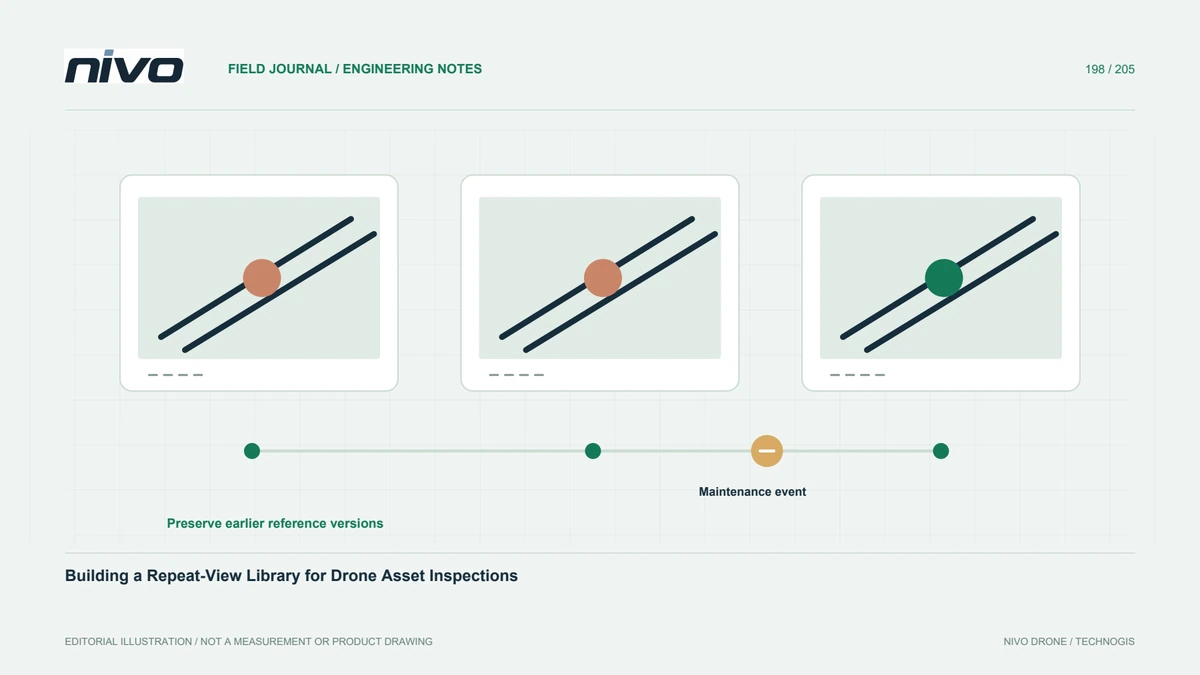
A repair, component replacement, or better observation method may justify a new reference. Retain the old one and document why the baseline changed. Do not overwrite history simply because a new image is sharper. Link reference versions to the relevant maintenance events and findings. This allows later reviewers to distinguish a new asset condition from a changed comparison basis and prevents long-running monitoring from silently losing the context behind earlier decisions.
Test retrieval and handover
Ask a colleague to find a component, retrieve its reference, and understand the latest comparison using only the archive. Improve missing context before expanding the library. Agree responsibility for updates and source retention. Discuss repeat-view requirements during NiVO camera acceptance using representative assets. The useful outcome is an accessible, traceable visual history, not a promise of identical observations under all conditions or automatic detection of every physical change from two similar-looking photographs.