Sony α6400 for Mapping: Evaluating Lenses, Capture, and Integration
Evaluate the Sony α6400 for aerial mapping through lens selection, repeatable focus, image intervals, installed payload requirements, and checks of the resulting dataset.
Place the camera within the survey requirements
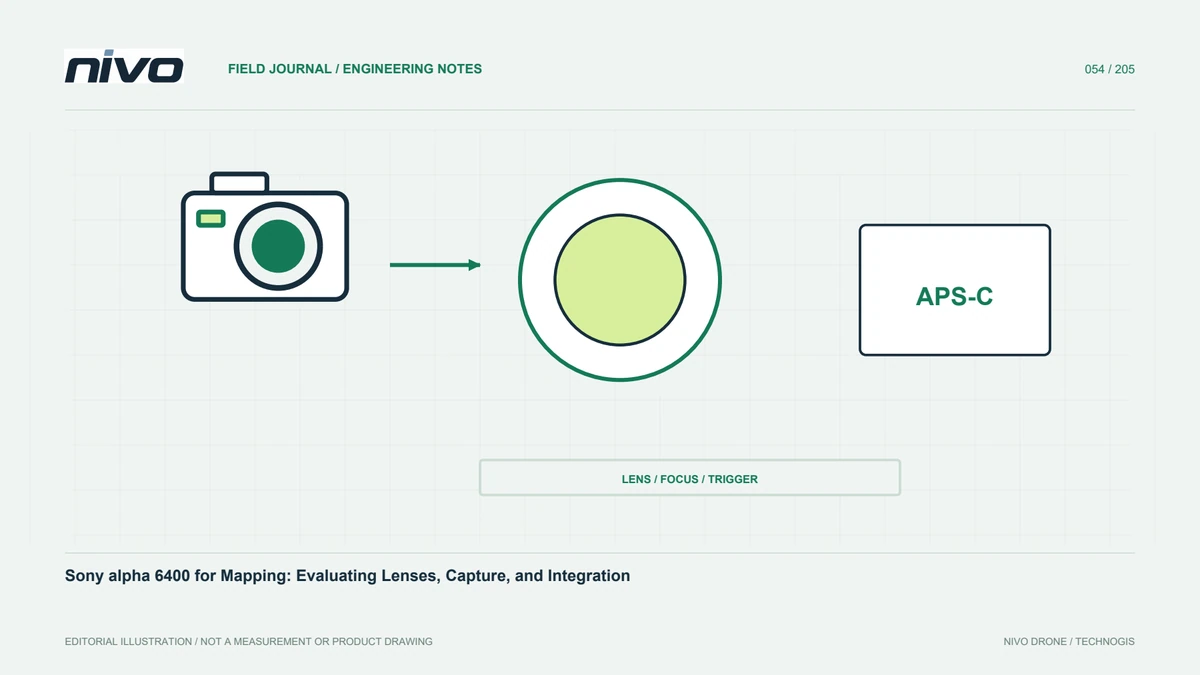
Sony specifies the α6400 with an APS-C sensor and approximately 24.2 effective megapixels. These are useful acquisition-planning inputs, not statements of map accuracy or universal aircraft compatibility. Begin with feature detail, project extent, terrain, and positioning requirements. Land documentation may prioritize consistent coverage, while smaller-feature work requires closer attention to sharpness. Record those needs before choosing height and focal length. The camera belongs within a survey workflow that also includes field control, processing, and independent evaluation of the final deliverables.
Select a lens for geometry and consistency
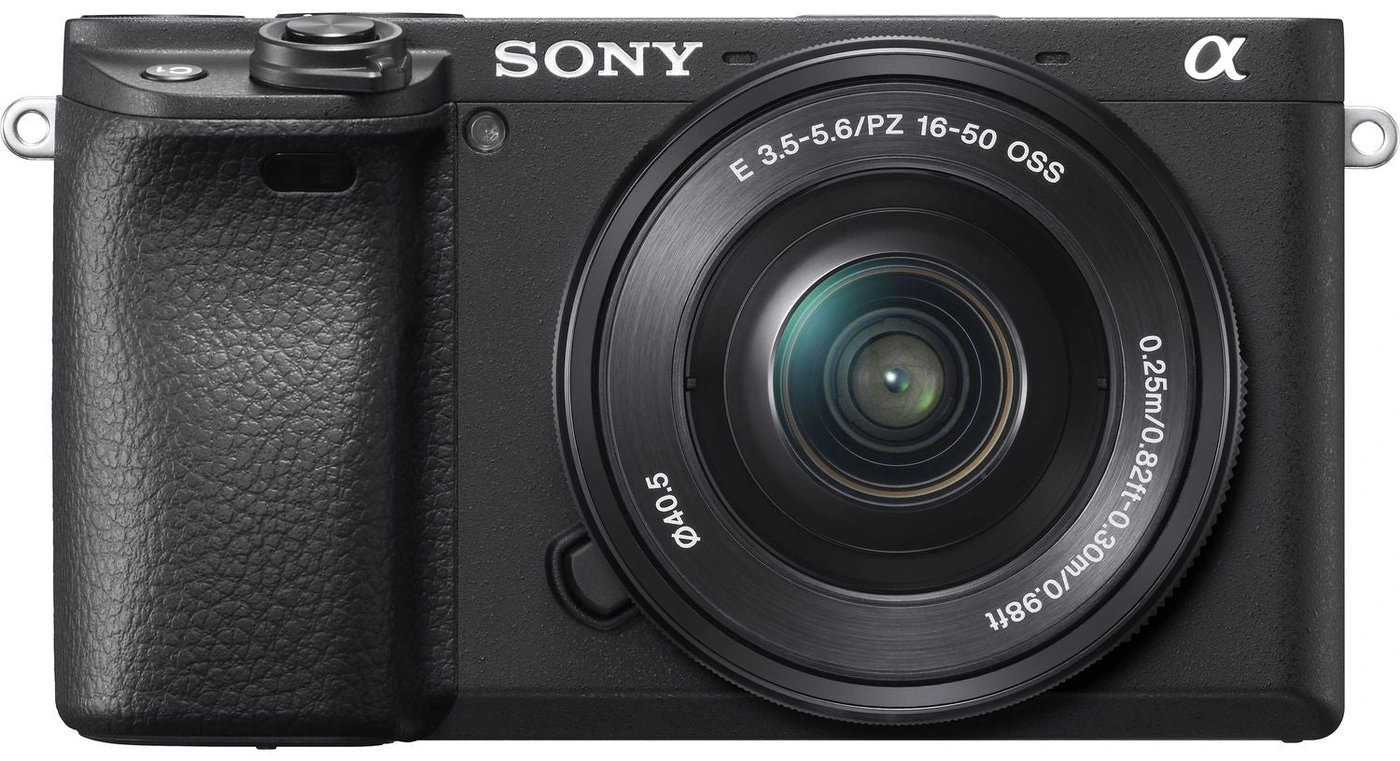
E-mount offers lens choices, but mapping selection should consider installed mass, distortion, edge quality, focus behavior, and mechanical stability. A fixed focal length can simplify repeatable configuration; zoom lenses require disciplined locking and recording of the selected position. The marking on a zoom ring should not be treated as a complete calibration definition. Capture and process a trial using the planned settings. Recheck the system after changing a lens or disturbing its mounting, even when the camera body remains unchanged.
Plan coverage over the actual terrain
Calculate field coverage from sensor size, image dimensions, and actual lens focal length. Relate it to camera-to-ground distance throughout the mission. Constant height relative to the launch point does not create constant ground clearance over slopes. Examine coverage and overlap at both high and low terrain. A field ending at an embankment may require additional planning at its edge. Include reasonable margins for variation, then verify actual captured images rather than assuming route lines alone prove that the block is complete.
Test image settings during representative movement
Compare focus, aperture, exposure time, and ISO using motion representative of the planned operation. A sharp stationary image does not prove adequate airborne detail. Inspect central and corner pixels across several textures. Record shutter mode and, where relevant, lens-stabilization behavior, following manufacturer guidance for the chosen arrangement. Change one variable at a time when diagnosing problems. Otherwise a successful repeat may not reveal whether focus, exposure, vibration, or lighting produced the improvement, making the result difficult for another operator to reproduce.
Demonstrate sustainable capture intervals
One successful exposure does not show that the camera can follow the required trigger interval throughout a survey. Run a sequence with the intended file format and storage card, including substantial data writing. Compare commands, stored photographs, timestamps, and planned capture locations. Look for irregular gaps or missing runs. If the interval is unsuitable, revise the acquisition design while preserving required overlap. Increasing software accuracy assumptions cannot repair photographs that were never recorded. Quantified capture testing is more reliable than relying on an unmeasured overlap margin.
Review installation and field handling
Count the body, lens, mount, trigger, cables, protection, and power source as one payload. Preserve practical access to buttons and storage so that routine checks do not disturb camera geometry. Confirm that the aircraft does not obstruct the lens and that wiring is secured without straining connectors. Inspect the arrangement after representative tests. Review α6400 integration for the specific NiVO model, installed mass, balance, and triggering method. The product page starts a technical discussion; approval needs an actual configuration and documented evidence.
Assess the dataset with independent checks
Process a short trial into the required output and assess geometry against independent checkpoints in the agreed coordinate reference. Examine error patterns by location and elevation, not only a summary statistic. One-sided softness may suggest optics or mounting, whereas a consistent displacement may indicate reference issues. Also review low-texture surfaces and long shadows that can hinder matching. Retain accepted examples and problematic photographs so that other operators understand the quality standard. This turns camera evaluation into a repeatable procedure rather than a visual preference.
Manage the configuration between surveys
Once a body-and-lens arrangement is accepted, record settings, equipment identity, firmware, storage media, and focus procedure. Keep examples of acceptable quality and conditions requiring repetition. Check whether another use of the camera changed its configuration before the next survey. Maintain sensor and lens cleanliness according to manufacturer instructions and team competence. If quality declines, compare with the baseline before replacing several components. Clear configuration management connects operators, aircraft technicians, and processors around evidence rather than recollection of how the camera was previously set.
Compare two lenses using a controlled trial
Use one representative test area and keep other conditions as comparable as practicable. Record coverage, image count, edge sharpness, and alignment results. Do not compare crops at different scales in a way that unfairly favors one lens. Include installed mass and ease of field access. If both lenses satisfy the deliverables, repeatability and handling cost can guide the choice. If one fails, retain the evidence so that the next experiment addresses a specific technical question rather than repeating an ambiguous comparison.
Illustrative case: comparing two lenses on one α6400
Imagine a hypothetical mapping team that already owns a Sony α6400 and is deciding between two lenses. Its first comparison uses a close crop from one image and a wide overview from the other, creating a misleading impression that one lens is automatically superior. The processor asks the team to restart with a shared question: can each installed configuration produce the required parcel map with readable boundaries and acceptable geometric checks? Both trials use a documented focus method, planned capture interval, and the same representative area, while recording any unavoidable change in light.
The team compares full-frame sharpness, coverage, image completeness, and processed outputs at equivalent viewing scales. It also records total installed mass and whether routine access requires disturbing the camera mount. If one lens performs poorly only near an edge, reviewers investigate that pattern before dismissing the camera body. The acceptance note preserves source images, settings, lens identity, and the specific failure observed. The selected lens is not described as universally best: it is the arrangement demonstrated for this workflow. A future lens replacement or mounting change triggers a targeted repeat using the stored trial dataset and feature examples as references, making later decisions easier to explain.
Two responses are explicitly compared if one lens has weak corners: investigate the installed optical arrangement, or redesign coverage so that the deliverable remains supported by tested imagery. Neither is selected merely to avoid an inconvenient retest. The handover includes a diagram showing which trial images support each output area and retains the unsuccessful examples. Acceptance requires a reproducible configuration and a clear explanation of any coverage workaround, including its additional capture and processing implications for the actual job rather than an isolated laboratory comparison.