Sony RX1R III 61 MP: Considerations for Mapping Image Acquisition
Assess the Sony RX1R III for aerial mapping by connecting its fixed lens and image detail with integration testing, data handling, and evidence from processed survey trials.
Identify the exact camera configuration
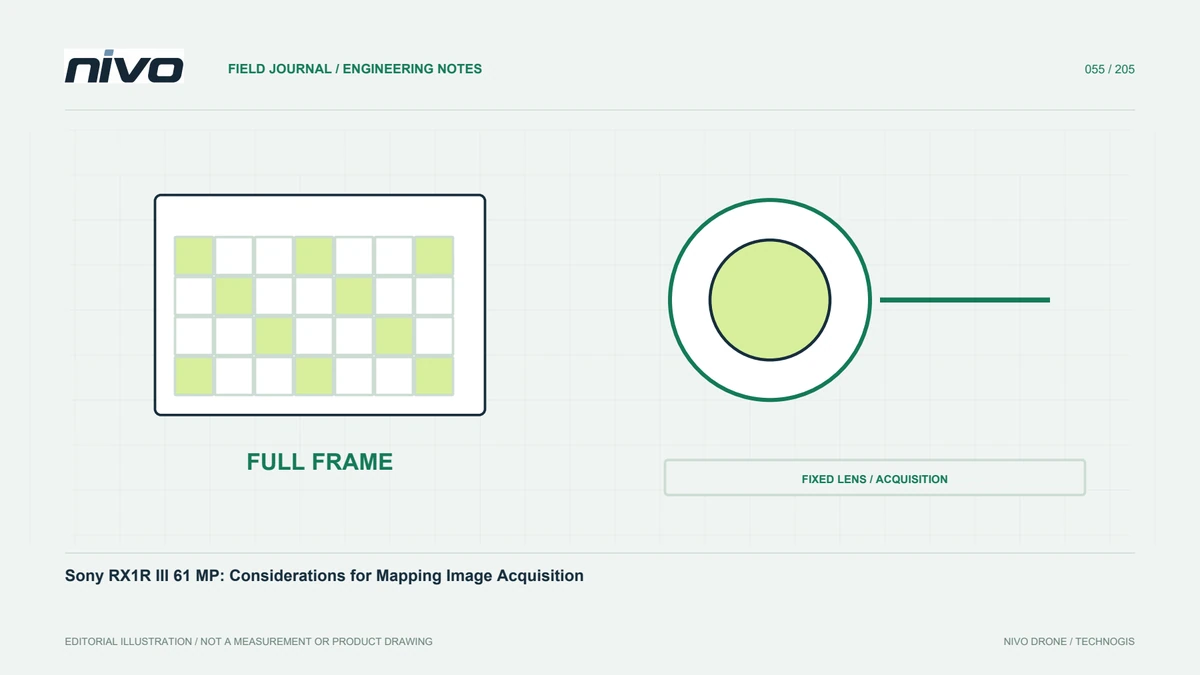
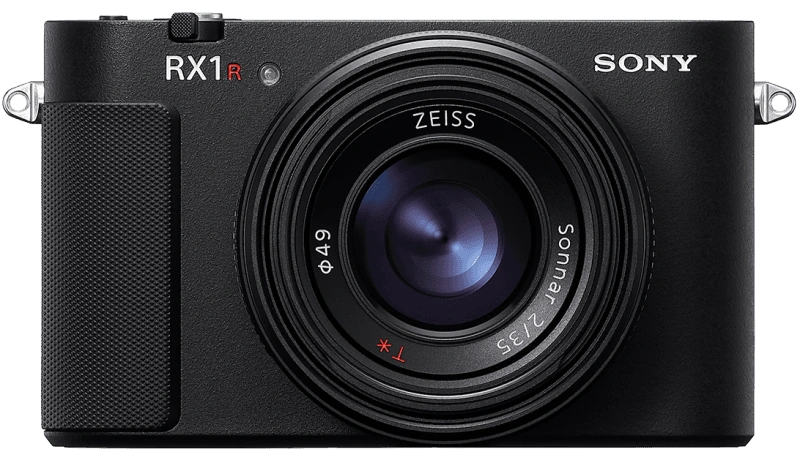
The Sony RX1R III combines approximately 61 effective megapixels on a full-frame sensor with a fixed ZEISS Sonnar T* 35 mm F2 lens. Identify the generation correctly because the RX1R family contains different specifications. These characteristics inform coverage and detail calculations; they do not establish positioning accuracy, trigger performance, or approval for a particular aircraft. Start with the intended deliverables and test whether the installed configuration records suitable images. The decision needs the complete acquisition and processing workflow rather than megapixels considered in isolation.
Use the fixed lens without overlooking calibration
A fixed lens simplifies focal-length documentation compared with frequent lens changes or zoom adjustments. Mapping geometry still requires evidence under working conditions. Focus position, temperature, installation, and vibration can influence the recorded images. Save the tested focus method and aperture. Nominal focal length is not a complete substitute for photogrammetric calibration parameters. Recheck after removing and reinstalling the camera. An accepted comparison dataset helps detect quality changes before they affect a large survey that would be expensive or difficult to repeat.
Specify the detail that changes a decision
High resolution can support small-feature recording when optics, exposure, and imaging distance preserve that information. Not every project needs maximum detail everywhere. Separate identification, geometric measurement, and visual-documentation requirements before designing the block. A regional basemap and a particular structure can require different capture strategies despite using the same camera. Calculate expected ground detail and compare it with actual examples. Do not promise reliable recognition of every one-pixel feature: identifying an object generally depends on a recognizable pattern and surrounding context as well.
Test exposure, focus, and sensor behavior
Small movements can become conspicuous when high-resolution images are inspected at original pixel scale. Compare stationary photographs with captures using representative motion and mounting. Review textured surfaces, contrasting lines, and building corners. Understand shutter modes through manufacturer documentation and integration tests. Software correction is not a reason to ignore acquisition defects. Relate recurring distortion or blur to flight direction, speed, and vibration. Record changes individually so that an improved result can be explained and reproduced instead of becoming an undocumented combination of adjustments.
Budget for storage and processing
More pixels can increase transfer, storage, review, and processing requirements. Estimate these using real files from the chosen configuration rather than megapixels alone. Include original data, backups, working copies, intermediates, and final outputs. Test capture sequences, card copying, and processing on the computer actually available. A rapid delivery schedule may be constrained more by data handling than by acquisition. Consider manageable blocks with adequate geometric connections. Avoid arbitrary image cutting that removes context required for alignment or breaks the traceability of source data.
Validate installation on the selected aircraft
Review the camera together with its mount, trigger, cables, and power source. Assess available space, lens clearance, storage access, ventilation, and aircraft balance. The integration team needs to understand startup, trigger response, and recovery after power interruptions. Where camera positions depend on GNSS, exposure timing also needs testing. The RX1R III catalog entry starts a NiVO consultation; it does not claim identical compatibility across the fleet. Document the approved arrangement and which later changes require renewed checks before operational use.
Prove quality through a processed trial
Choose a test area with different surfaces and elevations. Capture using the intended settings and process through the required orthomosaic and measurement outputs. Examine alignment, coverage, sharpness patterns, and independent checks in the correct coordinate reference. Visual detail and absolute accuracy answer different questions. Sharp images can still be poorly positioned when referencing is wrong, while favorable control statistics do not establish interpretability everywhere. Evaluate both sides before accepting the configuration or choosing the next change to investigate in a controlled repeat.
Choose a balanced operating package
Using the RX1R III should lead to a package covering the camera, aircraft configuration, inspection procedures, and processing capacity. Weigh the value of additional detail against data handling, operating logistics, and repeatability. Define acceptable image examples, retained documentation, and recapture criteria before fieldwork. If full resolution adds little practical value, evaluate an acquisition strategy better matched to the task. Discuss actual objects and desired outputs with NiVO so that consultation focuses on demonstrated outcomes and configuration boundaries rather than a camera specification considered separately from the project.
Distinguish information quality from file size
Two similarly sized datasets can carry very different useful information. Sharp, geometrically consistent images with sufficient overlap are stronger processing inputs than large files containing extensive blur. Summarize quality by block using detail examples, image distribution, and positioning checks. This helps the recipient understand why a dataset is accepted. Retain file size and resolution as metadata, but judge success by whether the observations answer the project question and whether the steps producing that answer can be traced and reviewed later.
Illustrative case: testing whether 61 MP changes the deliverable
Consider a hypothetical contractor evaluating an RX1R III for a mixed mapping assignment. Most of the area requires a general orthomosaic, while a small section contains features the recipient must distinguish individually. The team initially proposes capturing everything at the finest planned detail. Before committing, it processes a representative trial and asks the recipient to mark which additional details actually change the intended decision. This separates a genuine information requirement from a preference for large files or impressive magnification during presentation.
The project lead then develops two acquisition scenarios, documenting coverage assumptions, expected data handling, and connections between the general and detailed blocks. Neither scenario is accepted from calculation alone. The team checks captured sharpness, trigger completeness, processing time on its actual computer, and independent positioning evidence. If the detailed block adds useful information, its accepted examples become part of the capture standard. If it does not, the design is simplified without weakening the agreed deliverable. The configuration record identifies the exact RX1R generation, fixed lens, mounting arrangement, and tested settings. It also distinguishes image detail from absolute positional quality, ensuring that a visually sharp trial is not presented as proof of accuracy without the relevant checks.
The two scenarios are handed over with the same feature checklist so that extra detail is assessed fairly. Reviewers distinguish a feature that changes a management decision from texture that merely makes a presentation more attractive. The plan is accepted only when both the general block and any detailed block have complete source records, understandable joins, and a demonstrated processing route. Storage responsibilities are assigned before fieldwork, preventing a useful local improvement from creating an unmanageable dataset elsewhere in the project or obscuring which configuration produced each deliverable.