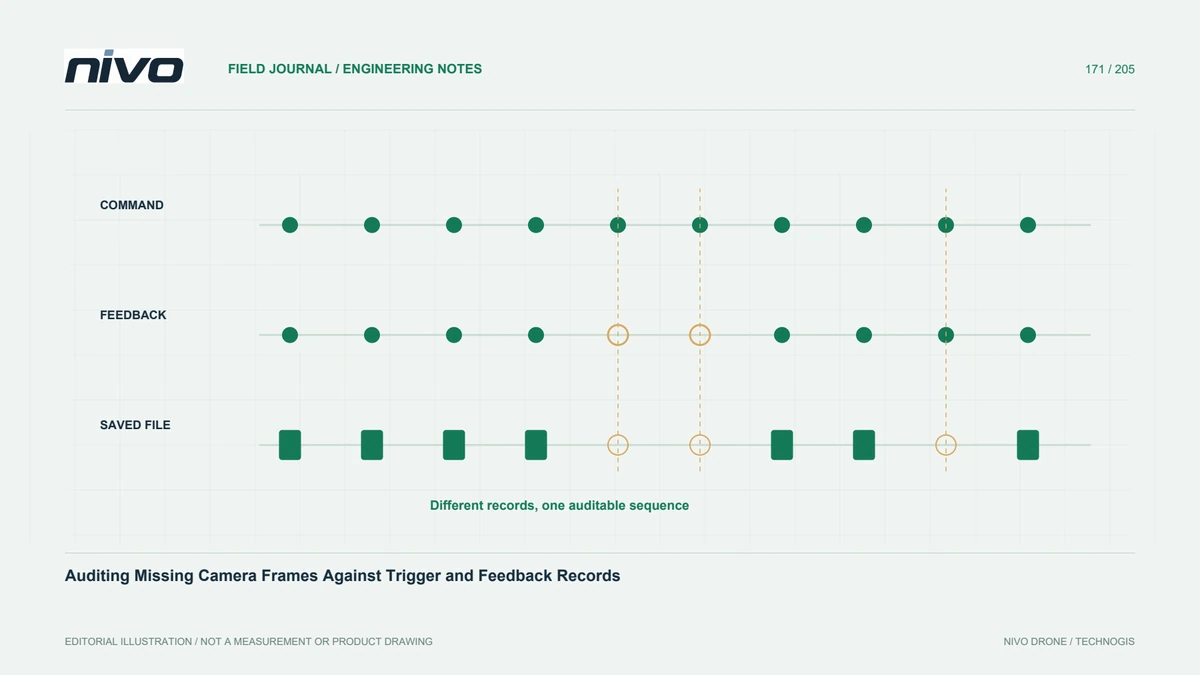
Auditing Complete Multispectral Capture Sets Before Processing
Check capture identities and required band files before reconstruction so a large file count does not conceal incomplete or mismatched multispectral observations.

Define one complete observation
A multispectral capture may consist of several related files rather than one ordinary photograph. Determine the required channels and how the actual device identifies a capture set. Use model documentation, not a guessed number based on another sensor. Also identify ancillary files needed by the selected processing workflow. A complete observation means the correct related inputs exist and can be read; it is not simply any group of filenames with similar timestamps.
Preserve the directory structure
Copy source data with its original identities and verify the copy before changing names or organization. Keep calibration captures distinguishable from survey captures. Record device, storage medium, flight, and any file-handling actions. Flattening folders from several flights can create collisions or hide missing relationships. The audit should allow reconstruction of the source inventory even if the usual operator is absent, and it should preserve evidence of how the data arrived from the device.
Build a capture-by-band inventory
Create an inventory showing capture identity, expected channel, file presence, readability, and relevant metadata. Use the device's actual identifiers when available. Check a small sample manually before trusting an automated grouping rule. Look for duplicate files, mismatched devices, and partial sets. A total divisible by the expected channel count is not sufficient: one extra file and one missing file can preserve the arithmetic while leaving the dataset analytically incomplete.
Review timing and channel correspondence
Files grouped together must represent the intended related observation. Examine metadata and representative imagery rather than relying solely on name similarity. Different band views may also require geometric alignment before indices are calculated. Keep completeness separate from alignment quality: every file can be present while correspondence is still inadequate. Where uncertainty remains, mark the capture set for review instead of allowing a processing import to silently decide its analytical status.
Evaluate the practical consequence
Map the locations of accepted and rejected sets and examine the remaining coverage. A few incomplete sets may have limited consequences in one arrangement and leave a critical gap in another. Test the actual processing requirement before deciding whether repetition is needed. Retain exclusions and their reasons. Do not manufacture a missing band from a neighboring exposure merely to satisfy an inventory, or present a substituted observation as if it were original sensor evidence.
Handover an explicit inventory
Deliver the accepted source list, incomplete-set register, grouping rules, and unresolved questions to the processor. Confirm that exported band order remains documented after reconstruction. Discuss device-specific collection behavior during NiVO payload integration and acceptance. The audit succeeds when another person can explain which complete observations support the analytical product and where evidence is absent, keeping file management, geometric quality, and radiometric correction as related but distinct checks.