Auditing Missing Camera Frames Against Trigger and Feedback Records
Build a frame audit that separates camera commands, exposure feedback, saved files, and spatial coverage so missing images are investigated with evidence.
Distinguish four different events
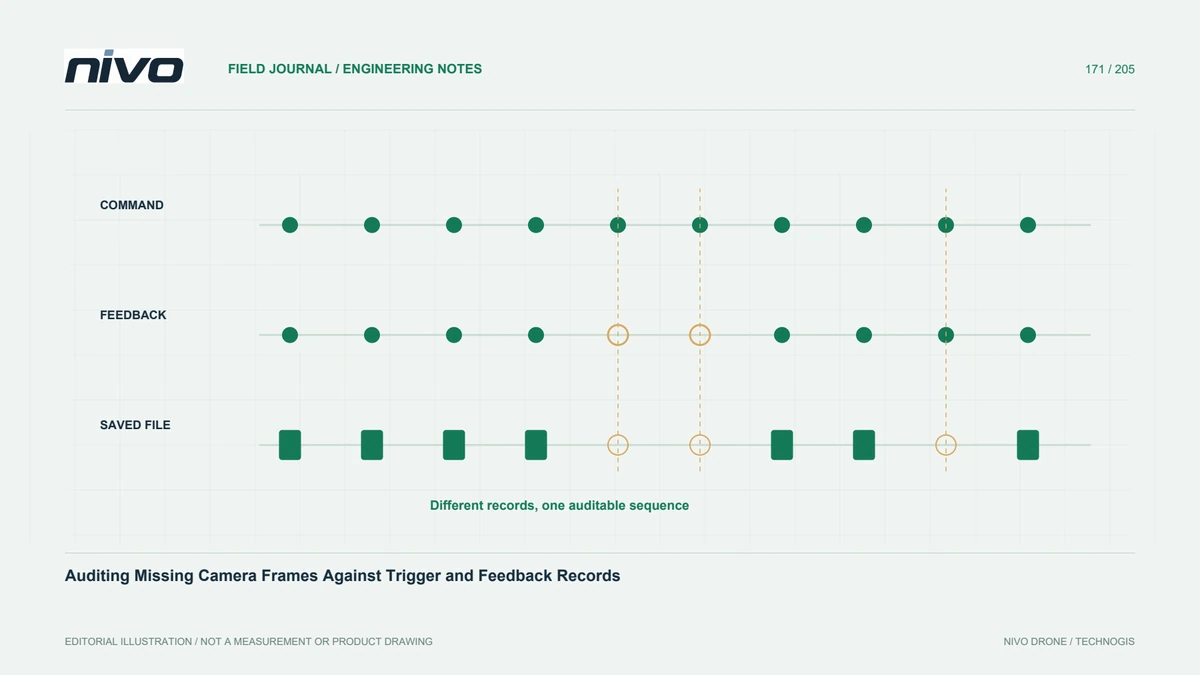
A planned capture, a trigger command, an exposure indication, and a usable saved image are different events. A count at one stage does not prove completion at the next. ArduPilot documentation distinguishes trigger records from camera feedback when a suitable connection is implemented. Confirm what the installed system actually records. This distinction creates an audit with meaningful evidence instead of assuming every mission command must have produced a corresponding photograph on the card.
Preserve the original records
Copy the relevant flight logs and camera files without renaming or overwriting the originals. Record aircraft, camera, card, mission, and clock information. Preserve timezone and timing assumptions for later reconciliation. A filename gap alone may reflect earlier use of the camera rather than a missed survey exposure. The audit should retain enough context to reconstruct the sequence, including pauses, separate flights, and test images taken before the actual mapping block began.
Build a comparison table
Create one row for each expected event with the available command time, feedback time, source-file identity, and review status. Leave unavailable evidence explicit rather than filling it by assumption. Explain how clocks were related and how uncertain matches were handled. Review small samples manually before applying an automated match across the dataset. A neatly aligned table is only useful when its matching rules respect the actual system behavior and known timing limitations.
Investigate the pattern of gaps
Look for isolated missing files, long missing runs, or problems beginning after a particular change. Compare the pattern with camera writing behavior, power observations, configuration, and operator notes. Do not assign a cause solely because two events happened near each other. Preserve alternative explanations until tested. The objective is a defensible account of what evidence exists and which part of the recording chain needs further technical investigation, not simply a plausible story.
Check spatial consequences separately
The same number of missing images can have very different effects depending on where they occur and the remaining coverage. Plot accepted image positions and inspect connectedness around the affected region. Test the reconstruction or inspection requirement there. Do not declare a block unusable solely from a percentage, or accept it solely because processing finished. Mark the actual evidence gap and decide whether repetition is needed while site access is still available.
Close the audit with an action
Record accepted files, unresolved matches, coverage consequences, and the technical follow-up selected. Retain any revised configuration and repeat-test evidence alongside the original finding. Share representative records during NiVO support consultation without claiming that one logging method exists on every installation. A completed audit lets another reviewer trace a missing-frame decision from command through available feedback to actual usable imagery, keeping system diagnosis separate from the practical decision about project deliverables.