Multispectral Radiometric Calibration: Preserving the Meaning of Image Values
Build a traceable multispectral calibration workflow using appropriate reflectance references, metadata, light observations, band checks, and transparent interpretation limits.
Distinguish appearance from measurement quality
A smooth, attractive multispectral image does not establish comparable analytical values. Pixel brightness depends on sensor response, capture settings, illumination, and the observed surface. Appropriate calibration addresses those relationships for the device and purpose. The objective is to preserve real differences, not make every parcel look similar. Color balancing is therefore not equivalent to measurement correction. Decide whether the result supports relative interpretation within one flight or comparisons across time with additional requirements. That decision determines which calibration inputs and quality checks are necessary.
Identify the device-specific calibration components
Camera families can store different parameters and metadata. MicaSense documentation explains relevant sensor and capture information for its workflows. Confirm software support for the actual model and data version. Do not apply another camera's coefficients merely because its channels appear similar. Record model, device identity, firmware, and calibration components. Reassess comparability after changing equipment. This inventory prevents errors that may be invisible in the finished display, such as processing a dataset with assumptions that do not match the device used in the field.
Maintain the panel as a measurement reference
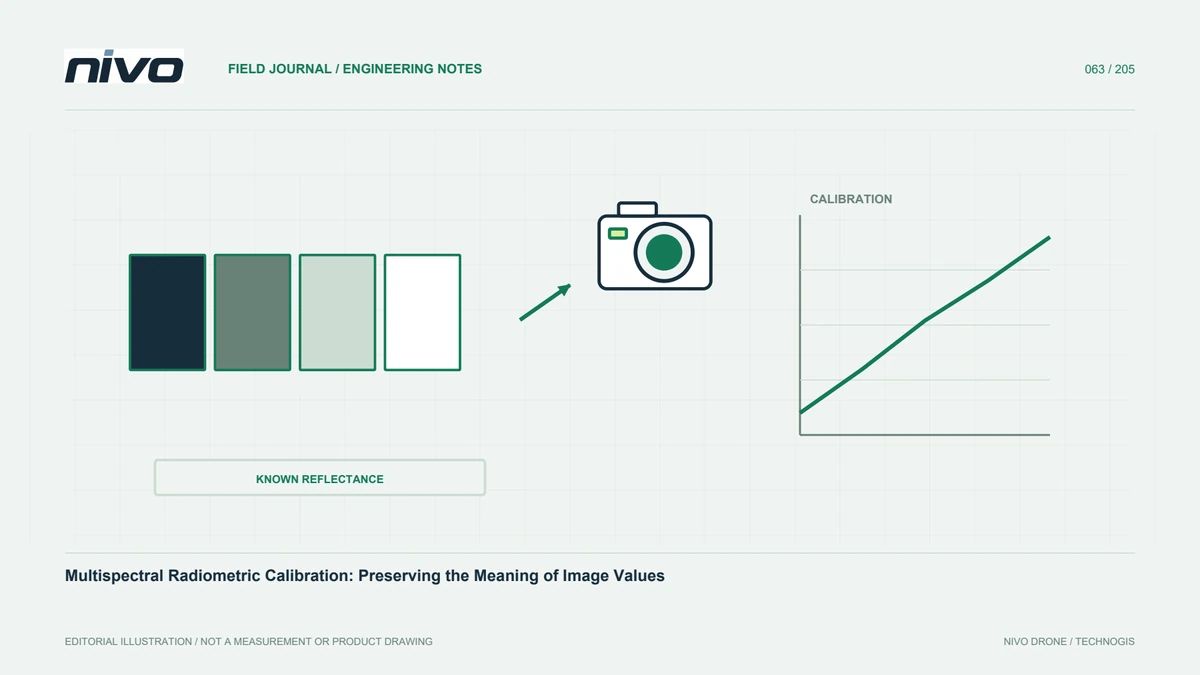
A reflectance panel belongs to the measurement chain and should be handled according to manufacturer guidance. Connect its identity and reference information correctly to the dataset. Surface condition, shadow, contamination, and capture technique affect usefulness. Follow the applicable procedure rather than inventing one rule for every brand. Review panel images before packing equipment and retain originals with flight data. A reference error can affect many images, making panel inspection a planned task with clear responsibility rather than an optional photograph taken when time remains.
Understand the light sensor's supporting role
An available light sensor can record illumination during acquisition, but installation and use must follow its guidance. Orientation, shadowing, connections, and configuration influence the meaning of the observations. Where the workflow requires both panel and light sensor, do not assume one replaces the other. Check metadata completeness and timing relationships. Log major weather changes. Tell the processor if light observations are absent or questionable before quantitative comparisons are prepared. Processing choices should reflect the inputs actually available and the interpretation boundaries that follow from them.
Separate radiometry from band alignment
Corrected values remain problematic when channels do not refer to the same position. Misalignment at canopy edges, roads, or small targets can create indices mixing different objects. Conversely, good geometry does not prove radiometric correction. Check both aspects independently. High-contrast features help assess alignment, while understandable reference areas can support value-consistency review. This separation improves diagnosis: the team should not adjust calibration parameters to solve a positioning defect or modify geometry when incomplete radiometric references are the underlying problem.
Preserve originals and processing order
Work from verified copies and retain unmodified source files. Record conversion, correction, alignment, mosaicking, and index-calculation stages. Do not overwrite analytical data with display-enhanced imagery. Document output scales and units so that later steps read values correctly. Keep software versions and parameters together. A traceable structure allows reprocessing after errors or when testing another method. In repeated monitoring, recipients need to distinguish changes in the object from changes in equipment or workflow; source preservation and versioned processing make that distinction possible.
Test consistency where the context is understood
Successful processing is not a sufficient quality test. Review comparison areas, treatment boundaries, and relatively stable features. Look for unusual block seams or patterns that follow flight lines more strongly than field structure. Investigate using metadata and weather notes. Do not flatten all differences because some may be genuine information. Mark unexplained patterns for further review and limit conclusions accordingly. Targeted checking protects analytical meaning while avoiding adjustments chosen merely to produce a visually uniform image that conceals uncertainty or real variation.
Explain comparison limits specifically
Two observations can use similar procedures while differing in sensors, season, soil, or growth stage. Calibration matters but does not control every other variable. Explain the comparison objective, available references, and known differences. If essential information is absent, avoid presenting value changes as definite biological changes. Support interpretation with field or ancillary data. Specific limitations tell recipients which parts remain useful and which need further evidence, making them more actionable than a generic statement that everything is only indicative regardless of its actual quality.
Agree a practical quality standard with the field team
Operators, processors, and recipients should understand their responsibilities. List required files, show acceptable reference images, and establish checks before leaving the site. Define problem reporting and recapture decisions. Review whether the procedure supports processing and analysis after the project. Simplify steps that are impractical without removing necessary measurement controls. A successful standard is consistently executable and creates a clear data trail. It keeps vegetation-index interpretation connected to the acquisition quality on which its meaning depends.
Illustrative case: a complete flight with an incomplete calibration record
Consider a hypothetical multispectral survey in which all planned flight images are present, but the processor cannot confidently associate one calibration reference with the correct device. The preview mosaic looks smooth, encouraging a suggestion to proceed and resolve the paperwork later. Instead, the team checks panel identity, original reference images, metadata, and the field log before claiming that values can be compared between blocks. The uncertainty is recorded as a specific missing relationship, not dismissed because the software completed processing without an error.
The operator and processor review whether the available records can establish the association without guessing. They preserve every original file and document any justified correction to the dataset inventory. If a required relationship remains unresolved, the analytical scope is limited accordingly and the need for additional acquisition is discussed while site access is still available. Display balancing is kept separate from the measurement workflow. The revised field checklist assigns responsibility for reviewing reference completeness before packing equipment and includes an example of the evidence that must accompany each flight. This scenario shows why calibration quality depends on identifiable inputs and a clear chain of records, rather than on a visually convincing mosaic or a completed processing status.
Two outcomes are recorded separately: a reference association recovered from defensible source evidence, and a reference relationship that remains unknown. The team does not apply the first outcome's conclusions to the second. Handover requires a calibration inventory showing which inputs supported each processed block and any limits on comparisons. The recipient can therefore approve an appropriately bounded use or request additional evidence. Keeping this distinction visible avoids a common failure in which a neat final map hides uneven confidence between blocks and the uncertainty is discovered only after decisions have already been made.