Using Flight Logs to Evaluate Drone Surveys
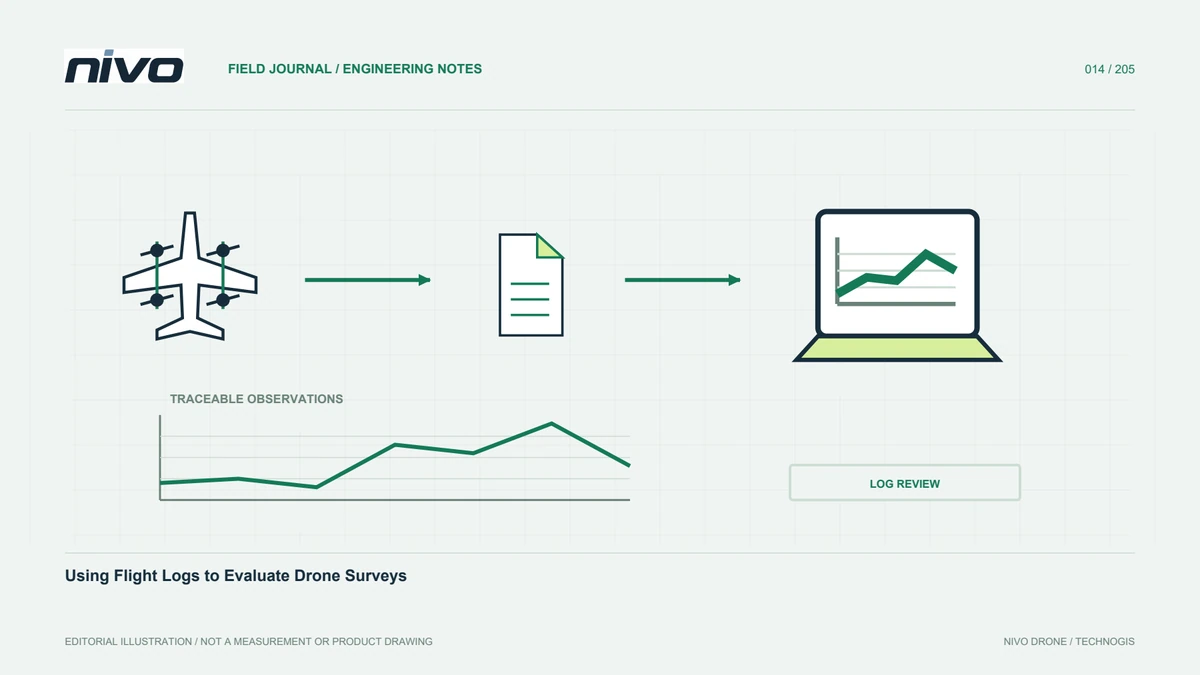
Connect flight logs with operator notes, payload configuration, mission versions, and sensor files so survey evaluation goes beyond interpreting a single graph.
Start with an evaluation question
A large log does not automatically provide an answer. Define the issue first: changed mission duration, image coverage, or an operator-reported event. The question determines relevant records and missing context. Opening graphs without knowing configuration and purpose encourages speculation. Assessment requires people who understand the system and its interpretive limits. This article organises evidence rather than offering automatic diagnosis or instructions to change parameters. The result should distinguish what the data shows from what the team still needs to investigate.
Identify the available record types
Records may come from the autopilot, ground station, sensor, or another device, with different content and timing. ArduPilot documentation distinguishes onboard records from ground-received telemetry records. Check which files the evaluation requires. A communication interruption can affect a ground record differently from an onboard record. Do not treat files as equivalent merely because one application opens them. List their origins, identities, and relationships before detailed comparison. That inventory prevents an information gap in one source being mistaken for proof about another part of the system.
Preserve originals and mission identity
Keep original files and use working copies for analysis. Link them with aircraft, date, mission version, battery, and payload. Several flights on one day need distinguishable names. Configuration changes must also be available. Otherwise, different graphs may simply represent different setups. Record unavailable information and downloading limitations. A defensible report identifies the evidence and its boundaries instead of hiding gaps behind a confident conclusion. The same records should remain understandable after the aircraft has moved to another assignment or a different analyst takes over.
Build an event timeline
Arrange relevant events from preparation to completion, including mode changes, acquisition starts, and observer reports. Understand time references before joining records. Camera, GNSS, and ground station times may differ in format or reference. Misalignment can make events appear in the wrong order. State unresolved timing relationships as a limitation. A timeline focuses detailed inspection and prevents discussion jumping between unrelated moments. It also provides a shared framework for operators and processors who may otherwise be describing different parts of the same flight.
Review indicators with context
One indicator rarely explains the system. Compare relevant position, attitude, speed, power, and messages according to the question. Understand units and sources. Coinciding changes are not by themselves proof of causation. Weather, observer notes, and configuration constrain plausible explanations. Use appropriate specialists where needed. Separate visible observations, supported explanations, and remaining hypotheses. This structure makes the next action testable: the team can state what additional evidence would distinguish competing explanations rather than moving directly from a graph to an unsupported setting change.
Link flight records with payload data
A tidy track does not establish successful survey acquisition. Compare imagery or sensor output with the planned time and mission section. Check trigger events, stored files, and actual coverage where information is available. Missing imagery is not necessarily a flight issue. Sample the beginning, middle, and end. Evidence helps the technical team distinguish sensor, timing, and acquisition-plan questions. It also allows processors to report a specific discrepancy rather than an unexplained quality complaint that cannot be connected with a flight or configuration.
Compare like configurations
Review payload, battery, software, and mission changes before comparing flights. If several factors changed, attributing a difference to one becomes difficult. Choose useful references and state factors that cannot be matched, including weather and access. A well-documented reference-flight collection can support future assessment without promising performance in every condition. It provides stronger context than selecting a graph because it appears to support a preferred explanation. Record the selection reasoning so another analyst understands why the chosen comparison was considered relevant.
Turn findings into verifiable actions
Summarise the question, evidence, conclusion, and follow-up. A solution may concern file identity, configuration records, or storage checks rather than parameters. Technical changes follow the aircraft approval and test process. Define the evidence used to assess their result. Do not close a finding because the next graph looks better without understanding what changed. Evaluation then becomes part of fleet and data-quality management. It avoids accumulating interventions whose apparent success cannot be repeated or separated from unrelated differences in the next mission.
Share learning the team can use
Keep an understandable summary with links to original records and configuration evidence. Use annotated timing where helpful. Training should demonstrate the distinction between observation and conclusion, not present one graph shape as a universal answer. Check whether actions improve the actual survey output and preserve changes the team can sustain. Logs are valuable because they connect events, systems, and results with revisitable evidence. That continuity supports the next operator, processor, or manager even when the original participants are no longer available to explain the job.
Illustrative case: investigating a difference between flight records
Imagine a hypothetical evaluation in which a manager notices that a recent mission took longer than a reference flight. A graph is circulated as evidence that the aircraft has become less efficient. The analyst first checks whether the comparison uses the same mission version, payload arrangement, and recording source. Operator notes reveal that the planned acquisition boundary had been revised, so the reference is not directly equivalent. The reviewer builds an event timeline and separates travel, acquisition, and other relevant phases before discussing possible causes. Onboard and ground records are identified rather than merged as if they contained identical information. Original files remain unchanged, and working copies carry the annotations. The processor contributes the actual image sequence, helping distinguish time that produced usable observations from time associated with a different part of the mission. No parameter adjustment follows solely from the initial graph. This illustrative scenario produces a report that separates observed differences, supported explanations, and questions requiring further checks. It also identifies a more appropriate reference for future comparison. The useful result is not a reassuring picture, but a repeatable explanation that another analyst can inspect without depending on the original participants' recollections.
The analyst can select a more comparable existing record, or propose an approved assessment designed to answer the remaining question. Either route is preferable to adjusting settings until a graph resembles the reference. The final handoff identifies the chosen comparison, relevant differences, and any conclusion that remains conditional. Annotated working files are kept separate from source records so another reviewer can challenge the interpretation. Acceptance of the evaluation concerns the clarity and reproducibility of its reasoning. It does not require the analyst to claim that every observed difference has a known cause when the available evidence cannot establish one.