When a Red-Edge Index Deserves a Place Beside NDVI
Evaluate NDRE as a defined analytical addition by checking actual bands, crop stage, calibration, comparison areas, and the field evidence needed for interpretation.
Start from a missed question
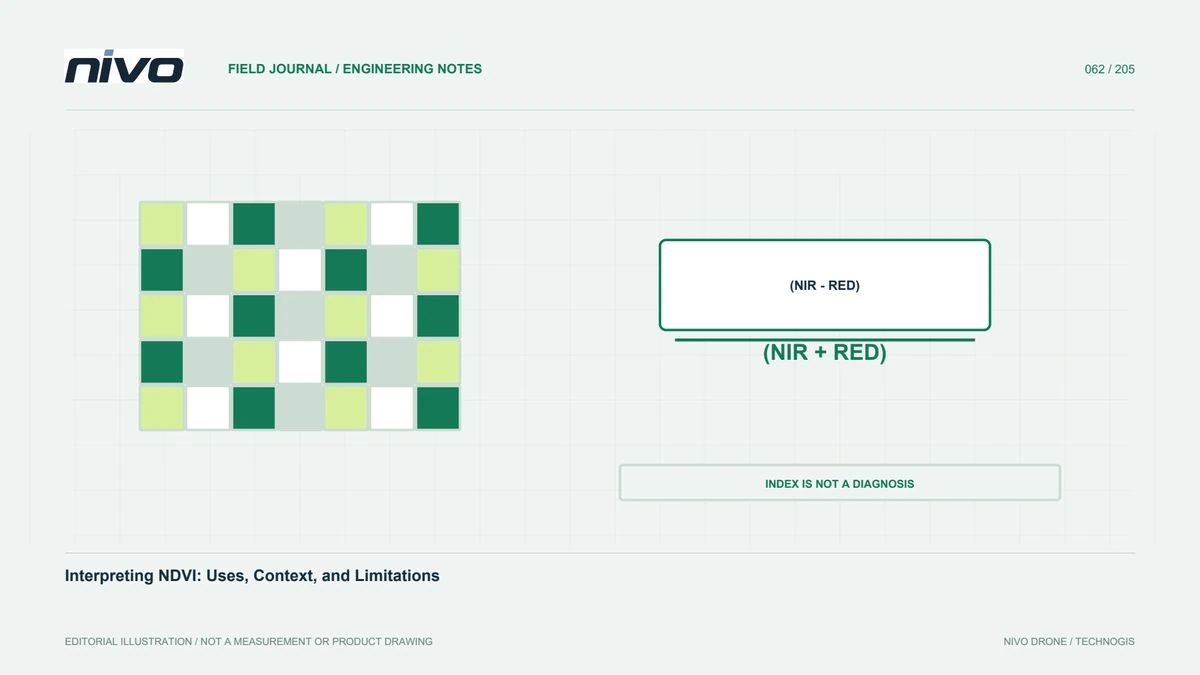
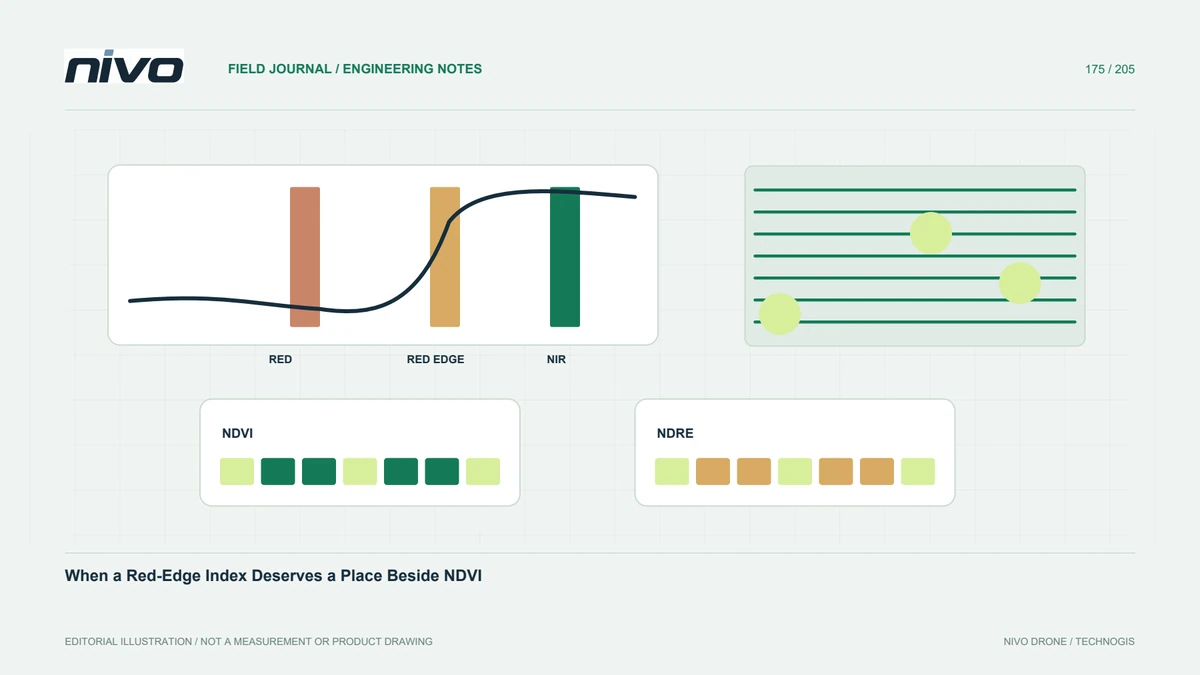
Adding another vegetation index should address a question the existing workflow cannot answer adequately. Identify whether the concern is variation within a developed canopy, differences between management zones, or another defined observation. NDRE uses near-infrared and red-edge information rather than the red band used by NDVI. That distinction makes it a candidate to evaluate, not an automatic diagnosis or a promise that one index is best for every crop and season.
Confirm the actual band definitions
Check the sensor model and exported band's identity before calculating an index. MicaSense notes that band order depends on the camera and processing output. Do not copy a raster expression that assumes a particular layer number into a different dataset without checking. Keep wavelengths or documented band names and the processing version in the record. For Landcam or another payload, obtain its actual documentation rather than assuming a red-edge channel is present.
Keep preprocessing comparable
Use appropriately calibrated, aligned, and reviewed data for the chosen analytical purpose. An index comparison is difficult to interpret when the underlying bands represent different locations or inconsistent correction paths. Retain panel and illumination records where required by the device workflow. Examine representative source regions before producing a farm-wide layer. A formula can complete successfully even when its inputs have the wrong order, unsuitable values, or incomplete spatial correspondence.
Compare patterns without declaring causes
Display NDVI and NDRE over the same relevant area with explicit legends. Look for places where the additional layer changes the question selected for field review. Consider canopy development, soil exposure, shadows, and management history. Different patterns do not automatically prove nutrient deficiency or determine a fertilizer requirement. The agronomic interpretation needs supporting evidence, and any relationship established in one project should not be transferred as a universal threshold to another crop.
Test usefulness with field observations
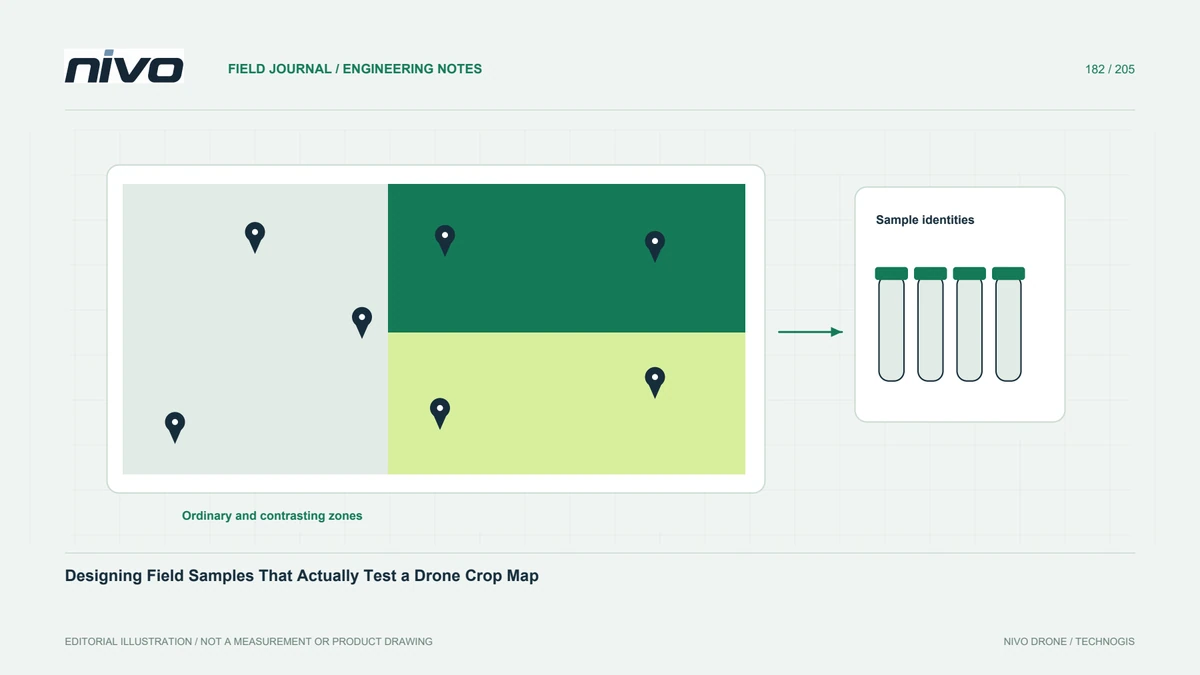
Visit areas where the indices agree and areas where they differ. Record observations independently of the preferred interpretation, including contradictory evidence. Ask the crop adviser what additional measurements are needed. A useful trial evaluates whether NDRE contributes relevant information to the decision, not merely whether its map appears more colorful. Keep the sampling design and interpretation notes linked to the index versions so the reasoning can be reviewed later.
Retain only justified analytical complexity
If the added layer improves a defined review task, document how it will be used and who interprets it. If its contribution remains unclear, keep it exploratory rather than embedding an unsupported rule in routine operations. Discuss band requirements and expected outputs during NiVO payload selection. The final specification should request demonstrated information capability and a reproducible analysis, while leaving model-specific compatibility and agronomic conclusions subject to their respective technical assessment.