Interpreting Bundle Adjustment Residual Patterns
Read residual distributions by image location, camera group, and survey position so systematic problems remain visible behind a low overall reconstruction error.
Identify which residual is being reported
Bundle adjustment jointly refines a reconstruction under an observation model. Its reports can include image reprojection differences, camera-position prior differences, and control-related residuals with different units and meanings. Identify the quantity before comparing numbers. A pixel residual cannot be interpreted directly as a ground-distance error without additional geometry, and an adjusted control residual is not equivalent to an independent checkpoint discrepancy.
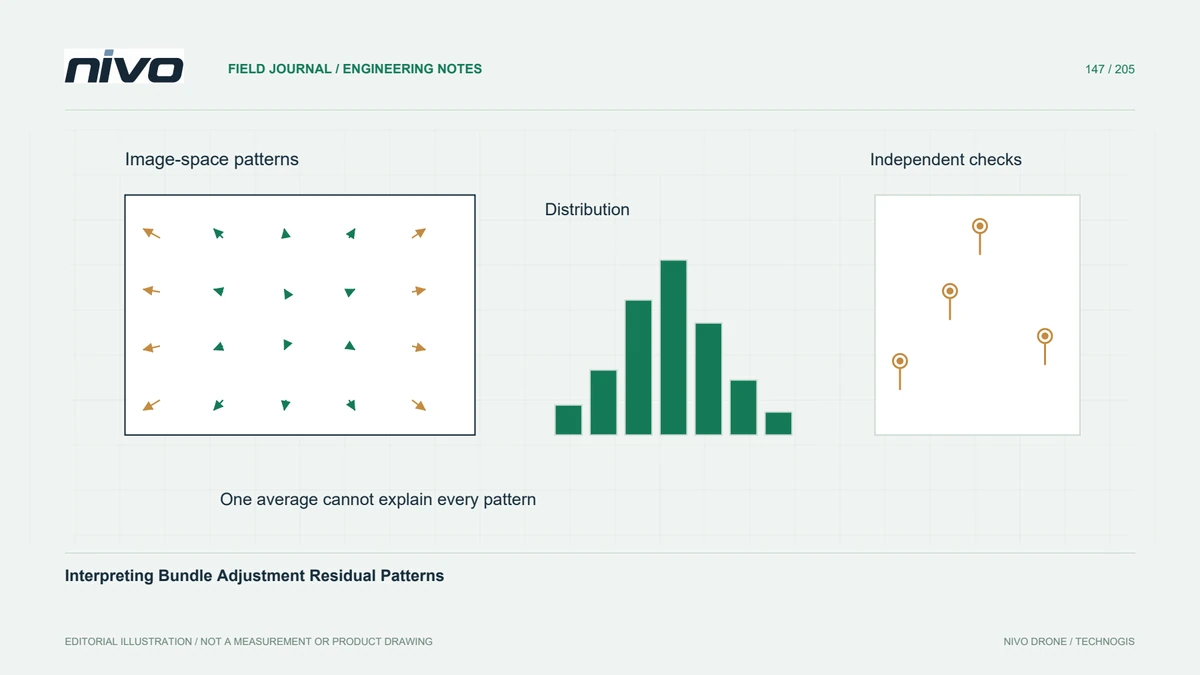
Inspect distributions and spatial patterns
An average can conceal a long tail of poor observations or a coherent pattern. Inspect the distribution and maps of residual direction and magnitude across image coordinates. A radial pattern near image edges suggests a different investigation from a few isolated large discrepancies. Use these patterns to formulate hypotheses about model assumptions or observations, rather than treating a low single summary as a complete quality statement.
Group evidence by acquisition conditions
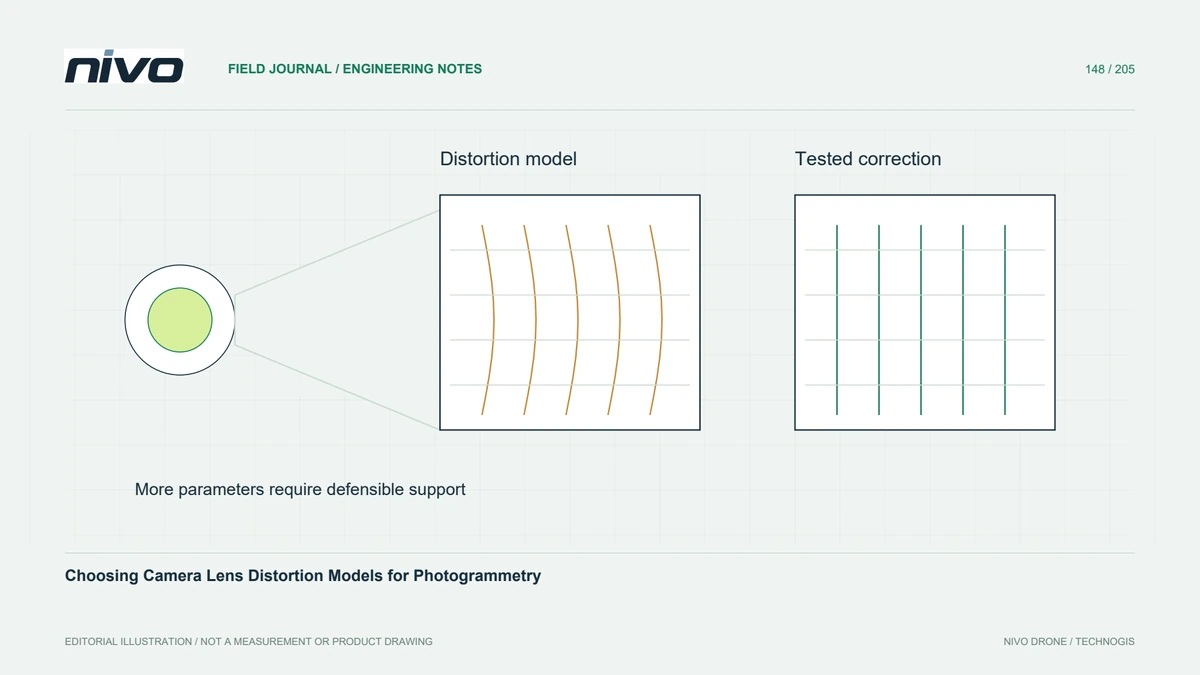
Compare camera groups, flight segments, image dimensions, and acquisition conditions. A problem confined to one group may relate to focus, metadata, or a different physical camera, while a site-wide pattern may indicate another cause. Keep group definitions grounded in records. Arbitrarily separating every image into its own calibration group can add freedom without creating the observations needed to constrain it.
Review outliers before removing them
Large residuals deserve inspection of the source image and correspondence. They may reflect a wrong match, a moving object, blur, a mistaken target observation, or an unsuitable model. Correct identifiable mistakes and record exclusions. Repeatedly deleting observations until an average looks satisfactory can remove valuable evidence of systematic failure and leave important parts of the block weakly supported.
Compare image fit with independent evidence
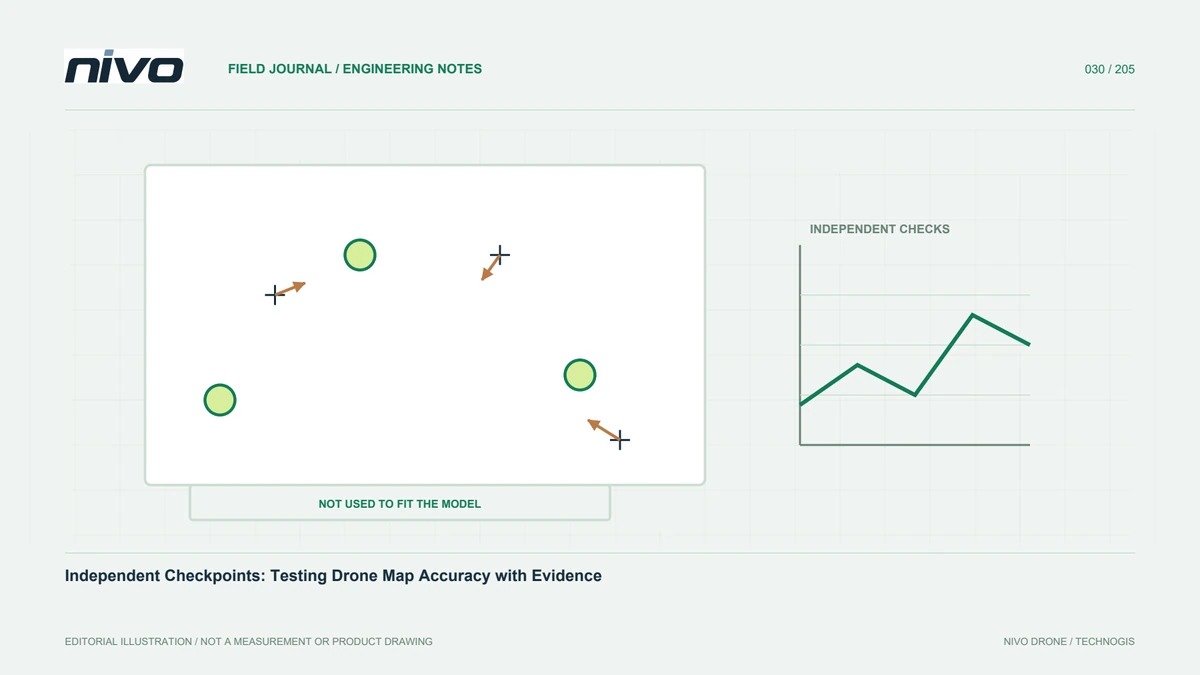
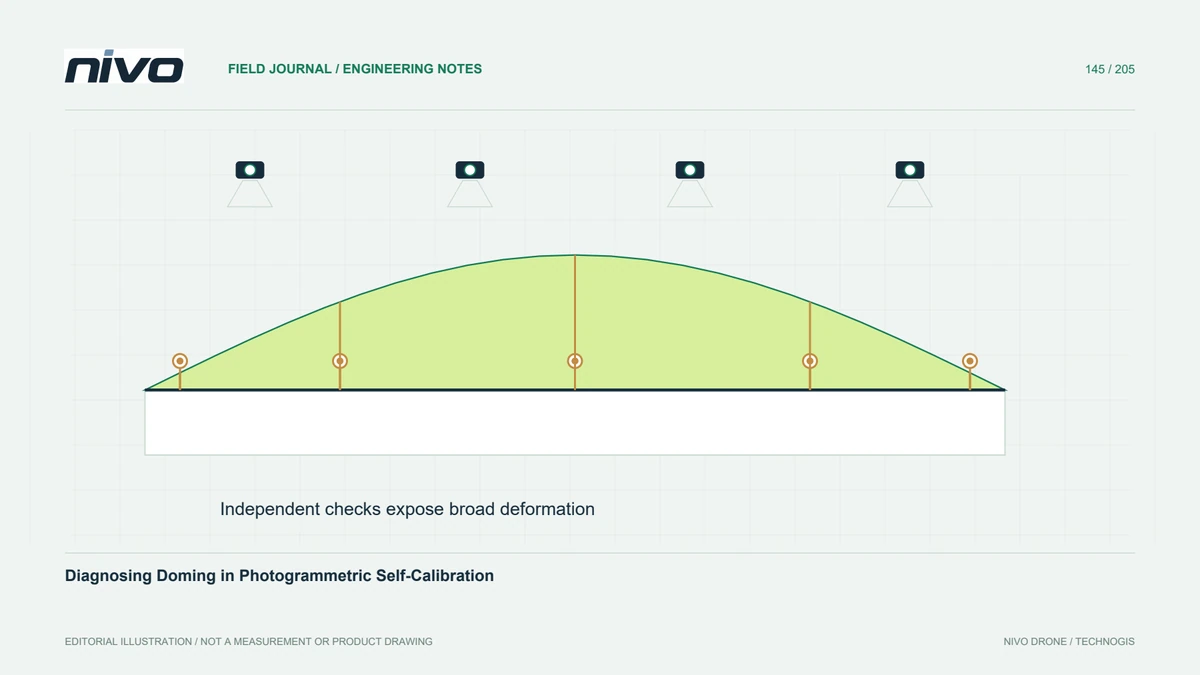
In a hypothetical mixed-camera survey, compare two processing configurations on the same observations and control. Review residual patterns, registered coverage, plausible camera parameters, and independent ground checks together. If one configuration lowers image error but worsens checkpoint behaviour, investigate the tradeoff rather than automatically declaring it superior. Keep withheld checks independent while choosing the model and report their actual role transparently.
Keep the diagnostic record with the model
Deliver a compact diagnostic summary identifying residual types, units, distributions, excluded observations, and selected configuration. Retain detailed plots and reconstruction reports for traceability. Acceptance should establish that suspicious patterns were investigated and external evidence supports the intended use. Residual analysis explains how well a model fits its inputs; it becomes meaningful quality evidence when interpreted alongside network strength and independent verification.