Choosing Camera Lens Distortion Models for Photogrammetry
Select a defensible camera model, preserve calibration conventions, and test parameter stability and independent geometry instead of assuming more coefficients improve accuracy.
Start with the physical imaging system
A camera model relates three-dimensional geometry to image coordinates and accounts for the projection and relevant optical effects. A conventional perspective lens, a fisheye system, and already-undistorted imagery should not be treated as identical inputs. Establish what the actual files contain, including any corrections applied before processing. The camera's marketing name alone does not describe the geometric state of an exported image.
Use appropriate model complexity
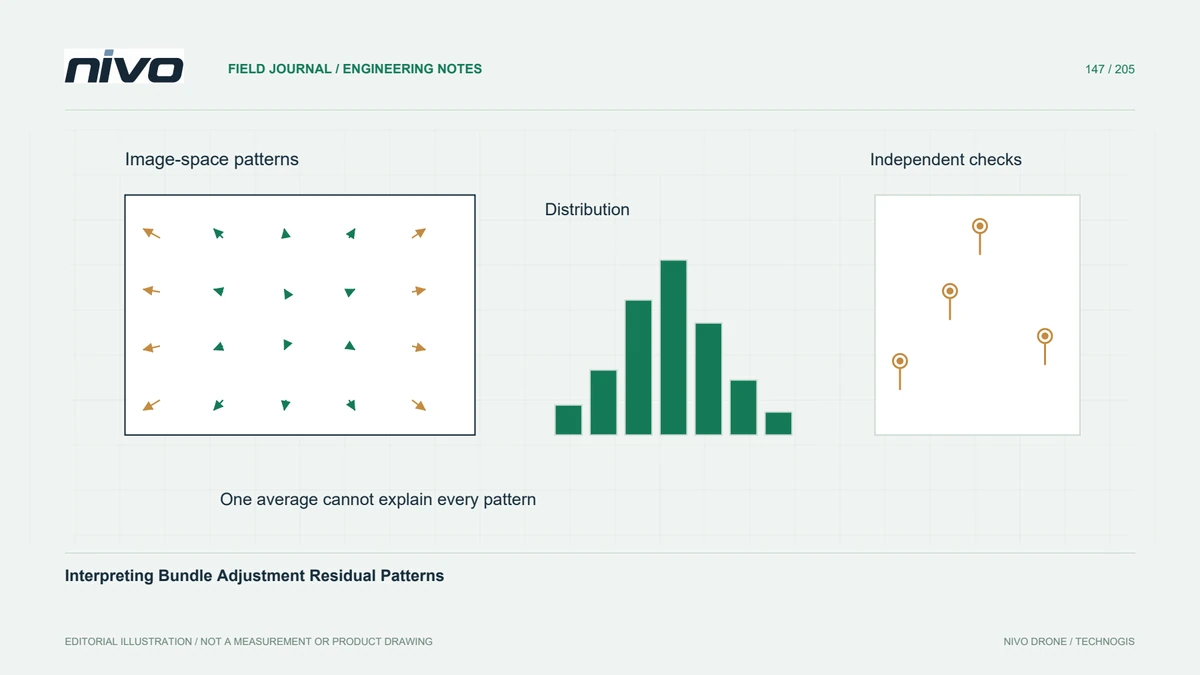
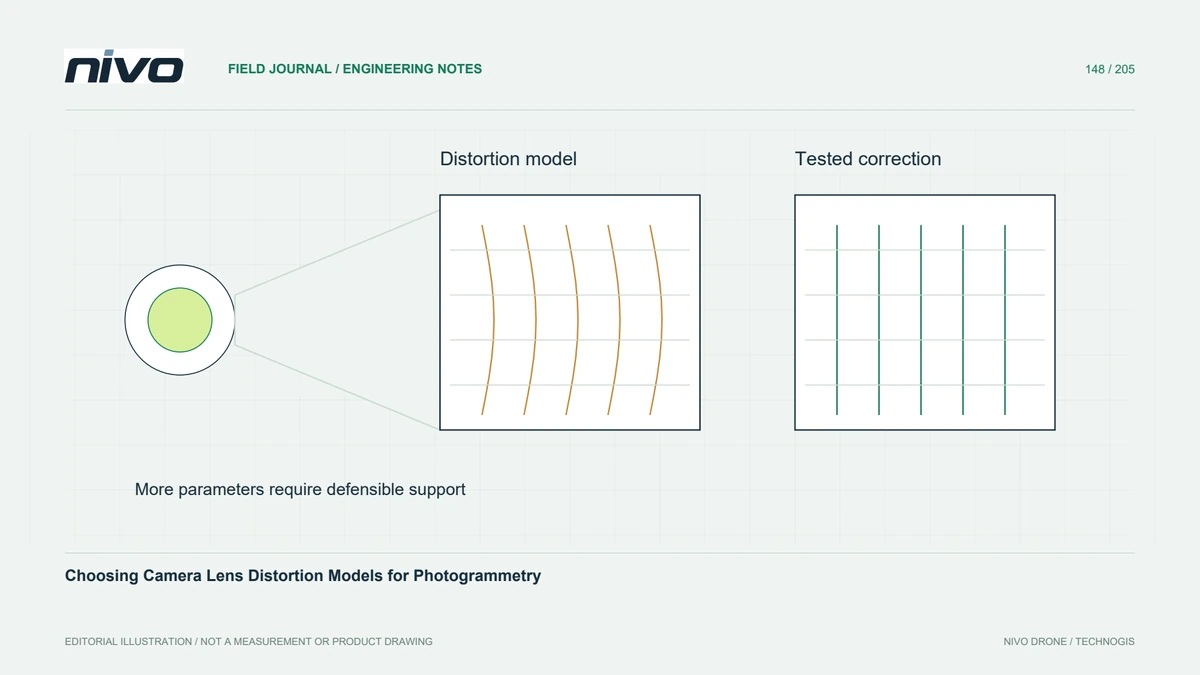
Choose a model capable of representing the relevant distortion without adding unsupported freedom. More coefficients can reduce a training fit while producing implausible or unstable calibration. Too simple a model can leave systematic patterns that the reconstruction accommodates elsewhere. Begin with a documented suitable model and inspect residual structure, parameter plausibility, and external checks before considering a more complex alternative.
Check parameter conventions during transfer
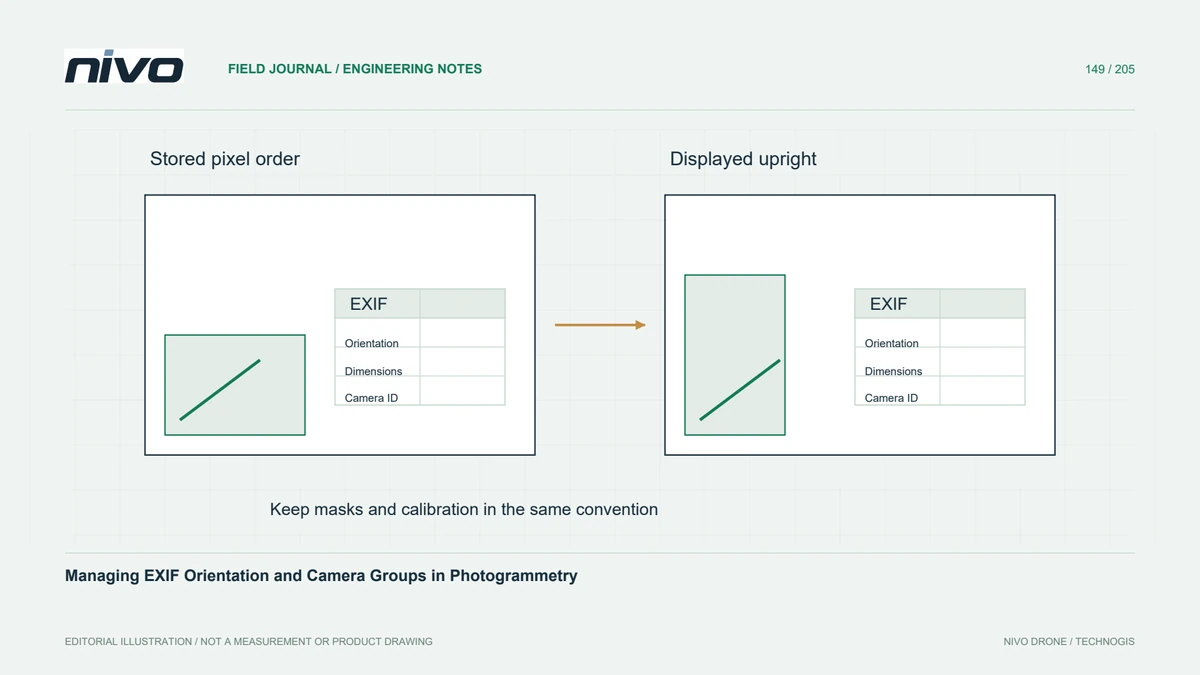
Calibration files from different tools can use different coordinate origins, normalisation, parameter ordering, and distortion formulations. Similar parameter names do not guarantee direct compatibility. Confirm image dimensions and the exact source and destination conventions before transferring values. Test the converted model on known image locations rather than pasting coefficients into another application's fields and assuming that a successful import establishes equivalence.
Group images by justified common calibration
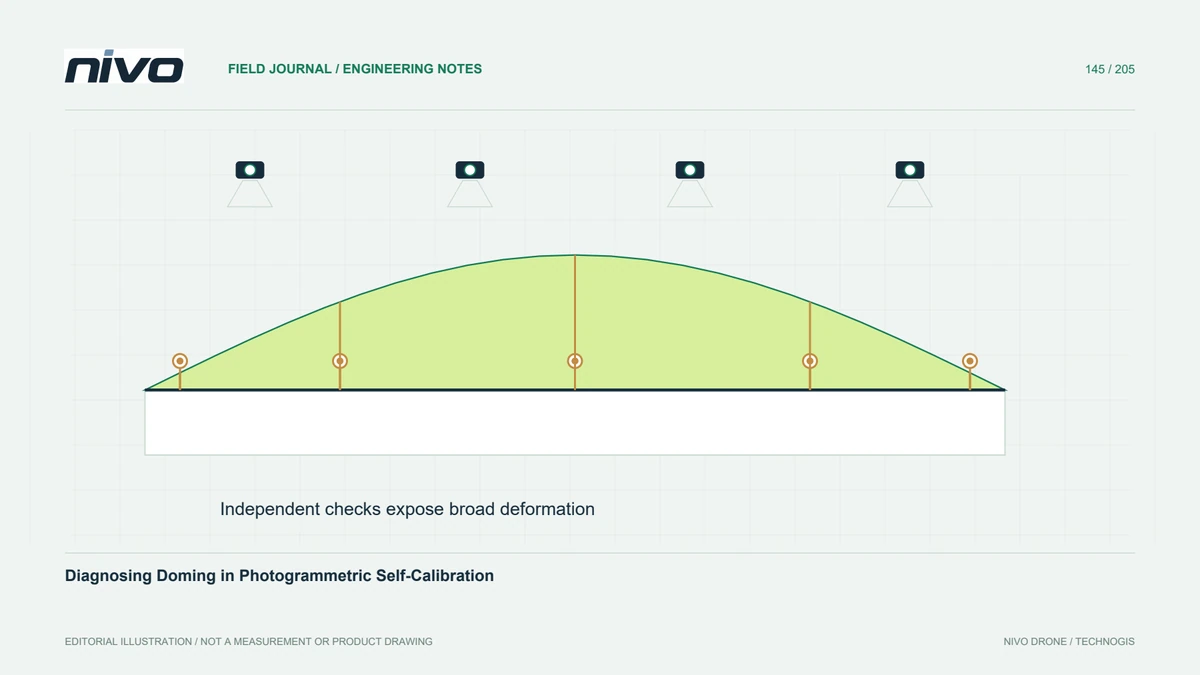
Share parameters only among images that reasonably represent the same imaging configuration. Focus changes, zoom changes, different lenses, or geometric image preprocessing may require separate treatment. Conversely, creating a separate calibration for every image can weaken estimation. Use acquisition records and file inspection to justify the grouping, then confirm that estimated differences are supported by the observations rather than compensating for other errors.
Test a representative block
In a hypothetical survey with two camera setups, compare justified model configurations on a representative connected block. Keep control and evaluation points consistent, and inspect both image-edge behaviour and object-space discrepancies. Reject configurations with implausible parameters even if one average statistic improves. If results remain ambiguous, obtain better calibration or acquisition evidence instead of selecting whichever option creates the smoothest terrain preview.
Deliver the selected model and its evidence
Deliver the projection type, parameter values, coordinate convention, image dimensions, camera groups, and whether parameters were fixed or refined. Preserve the calibration source and comparison results with the processing record. Acceptance should establish reproducible interpretation of the chosen model and useful independent geometry. A lens model is part of the measurement chain; it cannot repair missing overlap, blurred images, or incorrectly identified ground control.