Diagnosing Doming in Photogrammetric Self-Calibration
Look for broad systematic deformation using independent checks, camera-parameter review, and network geometry instead of judging a reconstruction by image fit alone.
Recognise a broad deformation pattern
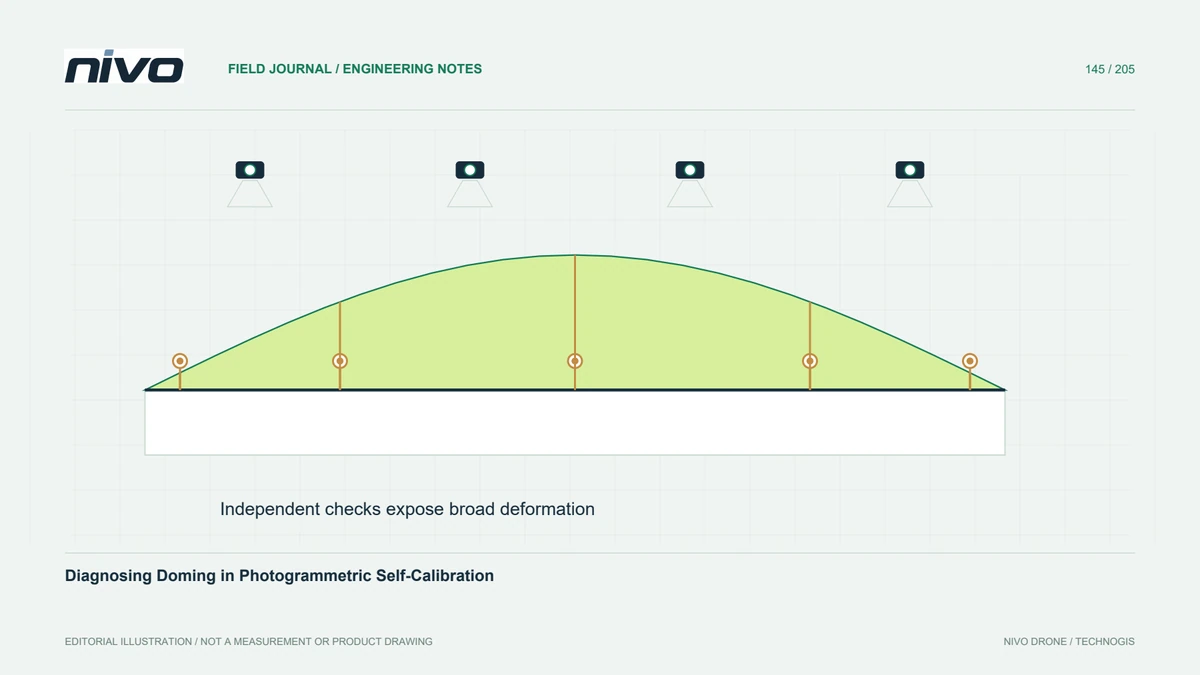
Doming or bowling describes a broad curved distortion that can affect a reconstructed surface even when local detail looks convincing. It should not be confused with a genuine hill, an incorrect height datum, or a constant vertical offset. Examine independent elevations across the block, including its centre and edges, and inspect whether discrepancies follow a coherent spatial pattern rather than isolated noisy observations.
Separate image fit from object-space checks
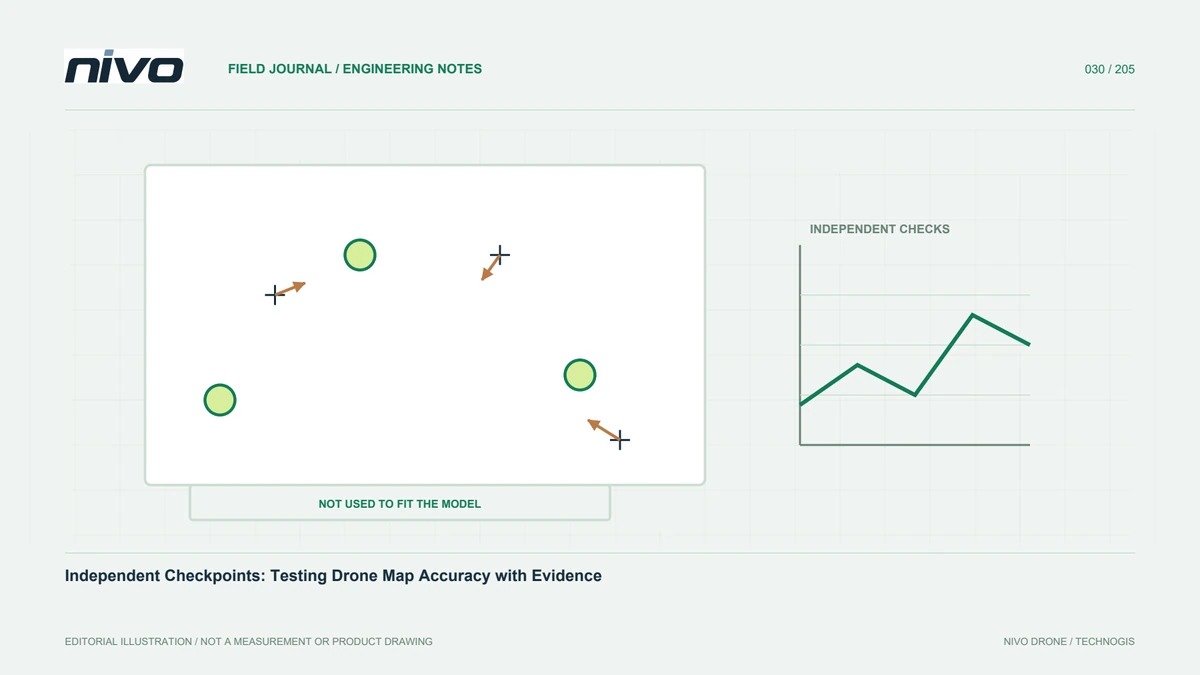
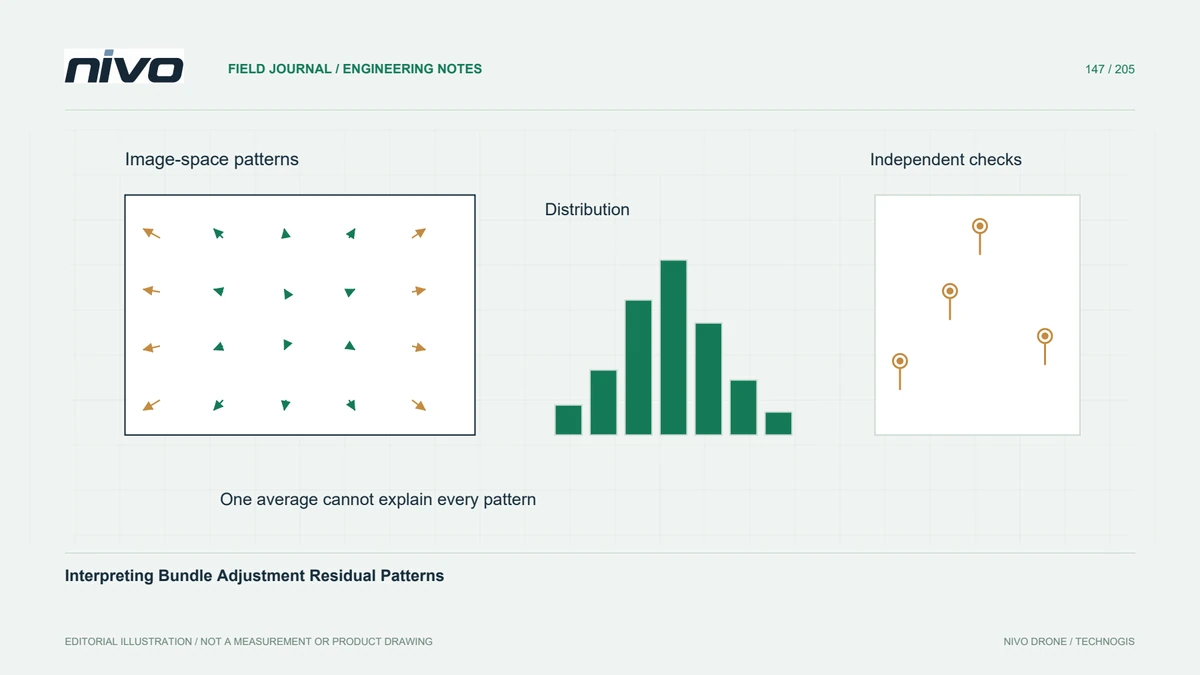
A low average reprojection error indicates image-space agreement under the estimated model; it does not independently prove accurate terrain heights. Parameters and scene geometry can compensate for one another within a weak network. Use checkpoints excluded from adjustment and compare signed errors by location. Do not convert check observations into control merely to reduce the displayed residuals without retaining a genuinely independent assessment.
Review the camera parameter assumptions
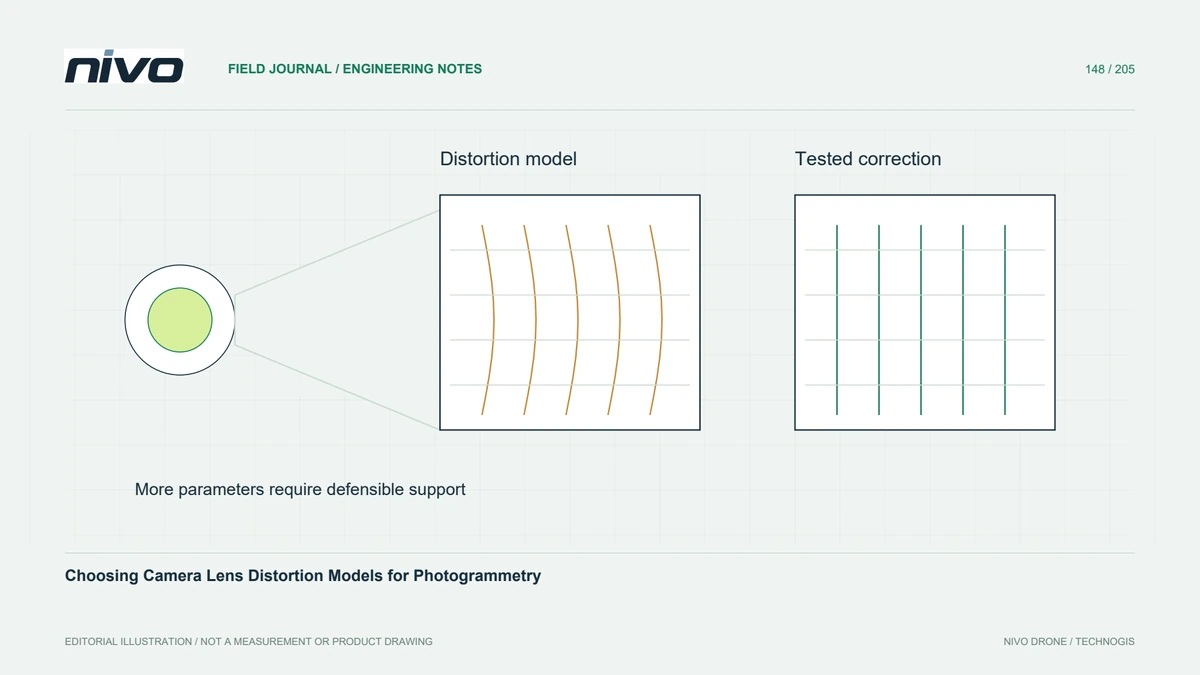
Review the selected lens model, camera grouping, focal assumptions, and whether parameters were fixed or optimised. A calibration from another focus setting or an incompatible model can be inappropriate. Conversely, freely estimating too many weakly constrained parameters may produce unstable results. Keep candidate calibration files and processing settings so differences can be attributed to a specific, documented change rather than an undocumented sequence of trials.
Inspect acquisition geometry
Inspect the image network for repetitive viewing directions, limited geometric diversity, and weak links across otherwise separate areas. Additional suitable viewing geometry can help constrain a reconstruction, but it must be planned for the actual platform, site, and required observations. More images with essentially the same weak geometry are not automatically equivalent to a better-constrained network.
Compare controlled processing alternatives
In a hypothetical broad, gently sloping site, compare a baseline reconstruction with one justified camera-parameter alternative while holding control and other settings constant. Review independent height patterns, parameter plausibility, and local detail together. If the existing imagery cannot resolve the ambiguity, identify the additional control or acquisition evidence required. Avoid selecting a result solely because its surface looks flatter or its average image error is smaller.
Record what the evidence actually supports
Deliver the diagnostic plots, independent check distribution, camera assumptions, and selected processing configuration with the terrain model. Explain remaining uncertainty and retain rejected trials as internal traceability where useful. Acceptance should demonstrate that the systematic pattern was investigated and the chosen result is supported by external evidence. A software option that sometimes reduces doming is a hypothesis to test, not a universal accuracy guarantee.