Resuming an Interrupted Mapping Mission Without Losing Coverage
Connect mission state, supported resume behavior, camera events, flight geometry, and source-image checks before accepting continuity after an interruption.
Record where useful acquisition stopped
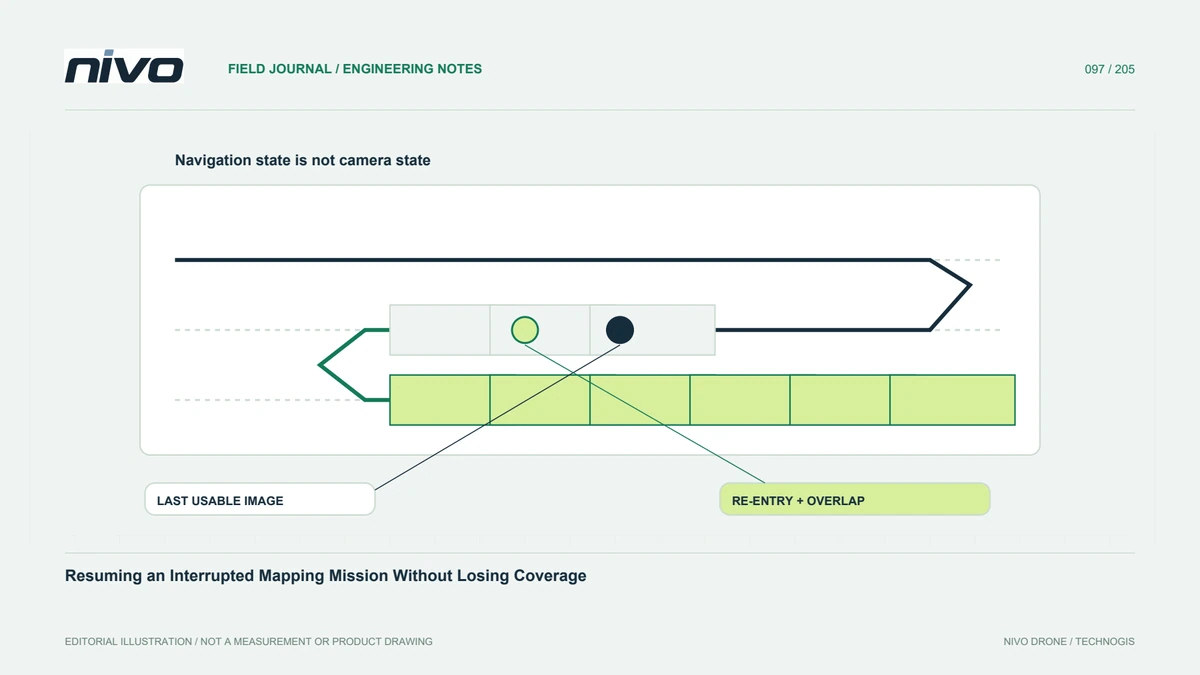
An interrupted mission has several relevant positions: the active waypoint, the aircraft's location, and the last usable observation. They may differ. Record the interruption time, reason, mission version, and camera state. A flight track passing through an area does not prove mapping images were recorded there. The data reviewer needs to locate the actual observation boundary before deciding how much continuity the subsequent mission must restore.
Understand the installed resume behavior
Supported autopilot behavior can resume toward an active item, restart, or use a configured rewind arrangement. Read the exact vehicle and software documentation rather than assuming the map continues from the visual break. Identify relevant mission settings and command history. The operator's approved process determines execution. This article concerns coverage evidence, not an instruction to switch modes or alter a live mission without the required operational assessment.
Include the geometry needed for usable images
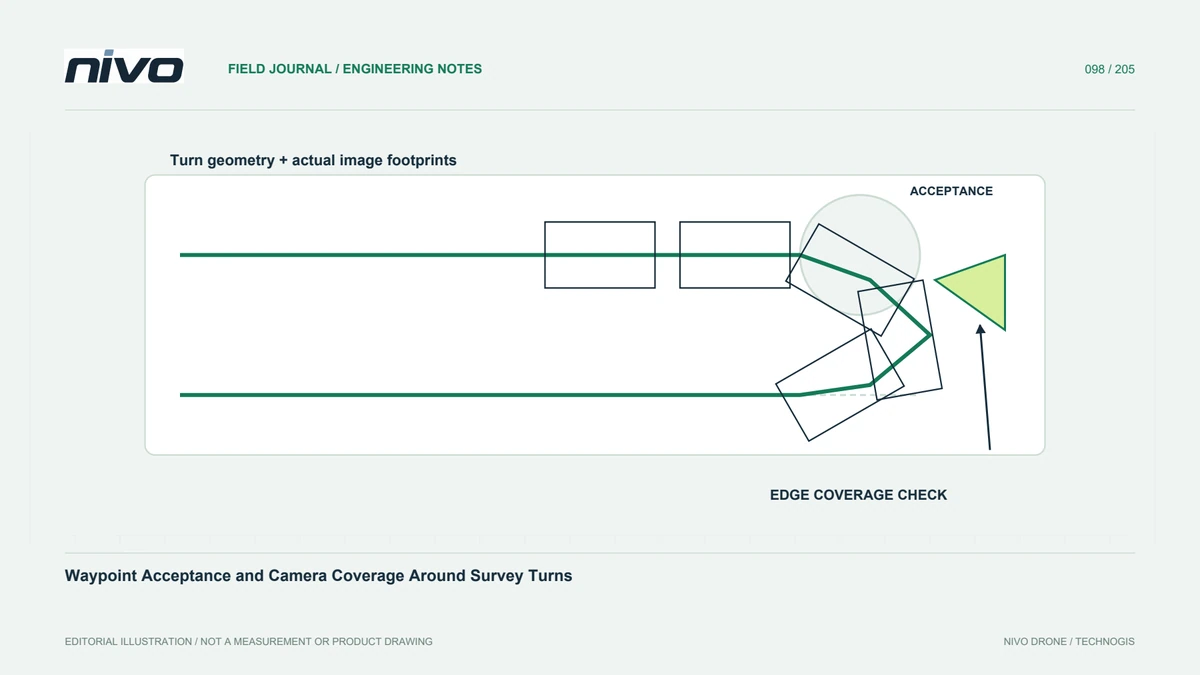
Returning to a coordinate is not equivalent to restoring the intended track, heading, attitude, and observation sequence. Review the re-entry geometry alongside the aircraft's operating limitations. A supported rewind function still requires suitable configuration and site evaluation. Do not choose a repeat distance solely to minimize duplicated photographs. The important requirement is enough valid common observations for the intended processing, demonstrated through actual source data.
Check triggering across the interruption
Compare camera commands, exposure events where recorded, image timestamps, and stored files before and after the break. Determine whether acquisition remained active during repositioning or restarted later. Extra images are not automatically useful, and missing files can be obscured by a large total count. Preserve the original sequence and mark accepted intervals. Arbitrary renaming or deletion before review can make a simple continuity question much harder to reconstruct.
Evaluate the join rather than the route alone
Plot usable image positions and review sharpness, overlap, and processing connections around the resumed section. Separate a genuine gap from intentional non-mapping travel. If the evidence is inadequate, identify a targeted follow-up area and the cause to address. Repeating without correcting the acquisition problem may reproduce the same failure. Keep mission segments linked so the processor understands which observations belong together and why a repeat was requested.
Preserve a complete continuity record
The final package should connect interruption reason, configured resume behavior, accepted imagery, join assessment, and any remaining limitation. A later reviewer should find the evidence without asking the pilot to recall the sequence. Use the finding to improve preparation and team reporting. This supports practical NiVO mapping workflows while keeping mission completion distinct from the more demanding question of whether the required information remains complete and processable.